“Few places in Pakistan let you stand beside 2,000 years of history in the morning and picture your own future by the water in the afternoon.”
| Key Takeaways 1. Jandial Temple is a 2nd-century BCE Indo-Greek site near Sirkap, part of the Taxila UNESCO World Heritage Site inscribed in 1980. 2. Its four Ionic columns make it one of the only Greek-style temple structures found anywhere in Punjab. 3. Lakeshore City sits within the same Taxila–Khanpur heritage and tourism corridor. 4. Heritage proximity supports steady visitor traffic and long-term location desirability — not a guaranteed return. |
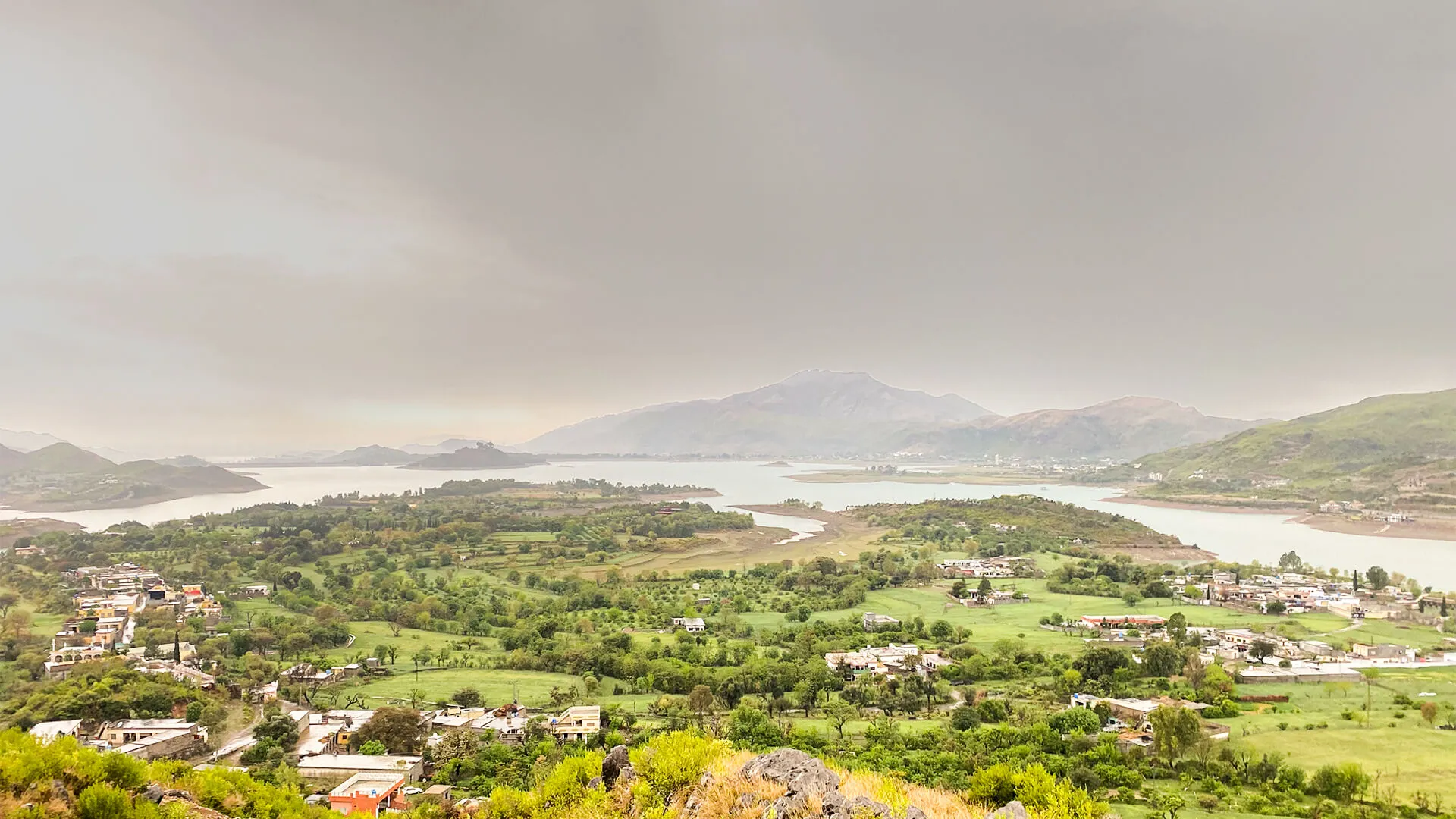
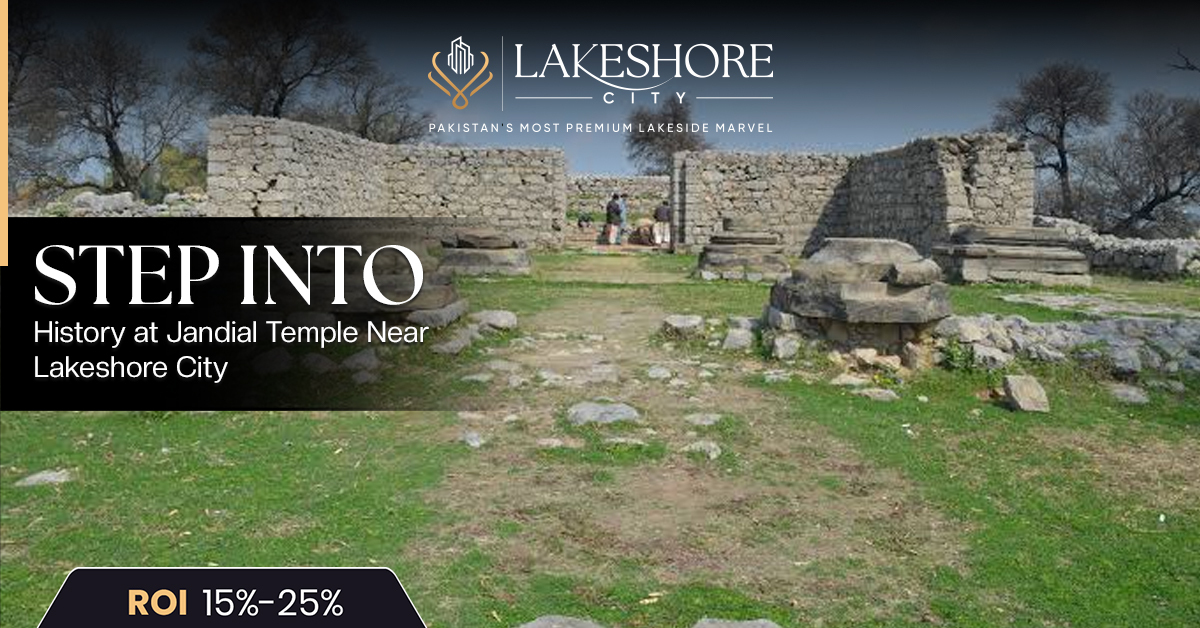
A few kilometers from where Lakeshore City is taking shape along Khanpur Dam, the ground holds a secret most travelers drive straight past. A row of weathered Ionic columns still stands where Greek settlers, Zoroastrian worshippers, and Buddhist scholars once crossed paths. Jandial Temple, tucked into the Taxila valley, is one of Pakistan’s most remarkable, and most overlooked, archaeological sites.
For anyone weighing an investment near Taxila, what surrounds a development matters almost as much as the development itself. Heritage doesn’t just add scenery. It adds permanence, footfall, and a story that outlasts any single sales cycle, and that’s exactly what Jandial Temple brings to the neighborhood around Lakeshore City.
What Is Jandial Temple?
Jandial Temple is a 2nd-century BCE Indo-Greek temple near Sirkap in Taxila, Pakistan, known for its rare Ionic columns and Greek-influenced layout. It is part of the UNESCO-listed Taxila archaeological site.
Jandial Temple was built around the 2nd century BCE, during the era when Indo-Greek rulers such as Demetrius and Menander governed the region. It sits on a raised mound roughly a mile north of Sirkap, one of ancient Taxila’s fortified cities. Four Ionic columns, cut from grey sandstone, still mark what was once the entrance porch, a layout lifted almost directly from classical Greek temple design, complete with the antae walls that framed a Greek doorway.
Archaeologists have debated its exact purpose for more than a century. Some read it as a Zoroastrian fire temple built in the Greek architectural idiom; others, including Pakistani archaeologist Dr. Saifur Rahman Dar, argue it was a Greco-Bactrian temple built by Greeks, for Greeks, far from home. Either interpretation points to the same conclusion: this was a place where cultures met and borrowed freely from one another.
That blend of Greek architecture in Pakistan, layered onto a landscape already shaped by Persian, Buddhist, and local traditions, is what makes ancient Taxila so unusual. Jandial is formally recorded as the “Jandial complex” within the Taxila UNESCO World Heritage Site, one of sixteen archaeological zones inscribed in 1980 for illustrating centuries of urban and cultural evolution along the Indus.
Why Jandial Temple Matters Today
A ruin only matters if people still visit it, study it, and protect it, and Jandial does all three. Its uniqueness (no other site in Punjab shares this exact Greek temple form) keeps it on the itinerary for archaeology students, heritage researchers, and international visitors tracing the aftermath of Alexander’s eastern campaigns.
Every visitor who walks through the Taxila Museum and out to Jandial’s columns is, in a small way, reinforcing Pakistan’s global heritage image, one that increasingly draws attention from cultural tourism circuits across Asia and beyond. For Pakistan, sites like Jandial function as quiet ambassadors, standing evidence that this land was a genuine crossroads for empires and ideas for well over a thousand years.
Why Its Location Adds Value to Lakeshore City
None of this is abstract for a property just a short drive away. Communities near recognized heritage destinations tend to see steadier weekend traffic, more family day trips, and a natural pull for educational tourism: school groups, researchers, and curious travelers who need somewhere to eat, stay, and return to.
Lakeshore City sits inside that orbit. Visitors who come for Taxila’s ruins, or for a day at Khanpur Dam itself, are already circulating through the same corridor where Lakeshore City is being built. As road infrastructure around Taxila and Haripur continues to improve, that circulation is likely to keep growing.
This is a genuine, if gradual, location advantage, not a guaranteed windfall, but a real pattern seen wherever heritage tourism and residential development share a corridor. Own a home surrounded by history and opportunity, and you’re not just buying proximity to ruins. You’re buying into a location with a standing reason for people to keep showing up.
Investment Benefits of Living Near Heritage Destinations
Heritage proximity tends to work in a development’s favor in a few concrete ways:
- Stronger location desirability — a heritage-adjacent address carries a story buyers can picture and describe to others.
- Tourism-driven economic activity — restaurants, guest stays, transport, and local services all benefit as visitor numbers rise.
- Long-term appreciation potential — steady, tourism-supported demand can contribute to value over time, though actual returns depend on market conditions and are never guaranteed.
- A distinct lifestyle — weekend access to a UNESCO-listed landscape without leaving the neighborhood.
- Growing regional development — better roads and rising visitor services across the Taxila corridor add prestige and future commercial opportunities in hospitality, retail, and tourism support.
Invest where culture meets future growth, and the location itself becomes part of the case for a purchase, not just the plot size or the price per marla.
Why Lakeshore City Stands Out
Few communities in Pakistan can genuinely claim what this corridor offers: a lakeside setting, a UNESCO World Heritage backdrop, and a modernly planned residential community, all within reach of one another. Lakeshore City was designed around that combination — nature at the water’s edge, history a short drive away, and infrastructure built for long-term living rather than a quick sale.
It’s a rare pairing of a premium lifestyle destination and a location with genuine cultural weight behind it. Experience a lifestyle connected to Pakistan’s greatest heritage, and it becomes clearer why buyers are treating this corridor as more than another development zone. It’s a place with a past that adds meaning to the future being built on it.
If you’d like to see the numbers behind the opportunity, you can view the latest payment plan or reserve your opportunity directly with the Lakeshore City team.
This same heritage corridor is explored from other angles in From the Timeless Planning of Sirkap to the Modern Vision of Lakeshore City and Jaulian Monastery both worth a read for the fuller picture.
Conclusion
Ruins like Jandial Temple survive because they still have something to say, about the empires that met here, the faiths that overlapped here, and the sheer staying power of a well-built structure. That same instinct, building something meant to last, is what shapes Lakeshore City today.
History inspires the future, and investing near timeless heritage creates value beyond real estate. Every landmark strengthens the story of your investment, and few locations in Pakistan can offer a story quite like this one.
Frequently Asked Questions
Where is Jandial Temple located?
Jandial Temple sits in the Taxila valley, roughly a mile north of the ancient city of Sirkap, in Punjab, Pakistan. It’s part of the wider Taxila archaeological landscape, about 30 to 35 kilometers northwest of Islamabad, reachable via the Grand Trunk Road or the Taxila–Haripur route near Lakeshore City.
Why is Jandial Temple famous?
Jandial Temple is known for its rare Greek-style architecture: four Ionic columns and a layout modeled on classical Greek temples, unlike anything else found in Punjab. Built around the 2nd century BCE during the Indo-Greek period, it stands as physical evidence of the cultural fusion that once defined ancient Taxila.
Is Jandial Temple part of UNESCO Taxila?
Yes. Jandial, recorded officially as the “Jandial complex,” is one of the listed components of the Taxila UNESCO World Heritage Site, inscribed in 1980. The wider site includes Bhir Mound, Sirkap, Sirsukh, and several Buddhist monasteries alongside Jandial.
How far is Jandial Temple from Islamabad?
Taxila, where Jandial Temple is located, is roughly 30 to 35 kilometers northwest of Islamabad, generally about an hour’s drive depending on traffic and route. Lakeshore City sits within the same broader corridor, along the Taxila–Haripur road near Khanpur Dam.
Why is Lakeshore City an attractive investment location?
Lakeshore City combines a lakeside setting near Khanpur Dam with proximity to a UNESCO World Heritage landscape, modern master planning, and improving regional infrastructure. That mix of natural scenery, heritage tourism, and planned development gives the location a distinct long-term identity beyond a typical residential project.
What historical places are near Lakeshore City?
Beyond Jandial Temple, the surrounding Taxila region includes Sirkap, Bhir Mound, Jaulian Monastery, Mohra Moradu, the Dharmarajika Stupa, and the Taxila Museum, all part of the same UNESCO-listed archaeological landscape that gives this corridor its cultural depth.
Can heritage tourism increase property value?
Heritage tourism tends to support steadier visitor traffic, local business activity, and long-term area desirability, all of which can contribute to appreciation over time. That said, real estate returns depend on many factors, and heritage proximity should be seen as one contributing advantage, not a guaranteed outcome.
Is Taxila becoming a stronger tourism destination?
Yes. Ongoing conservation efforts, museum upgrades, and growing interest from domestic and international travelers have steadily raised Taxila’s profile in recent years, reinforcing its position as one of Pakistan’s most significant heritage tourism destinations.
| Ready to See Where History Meets Opportunity?Register your interest today |