
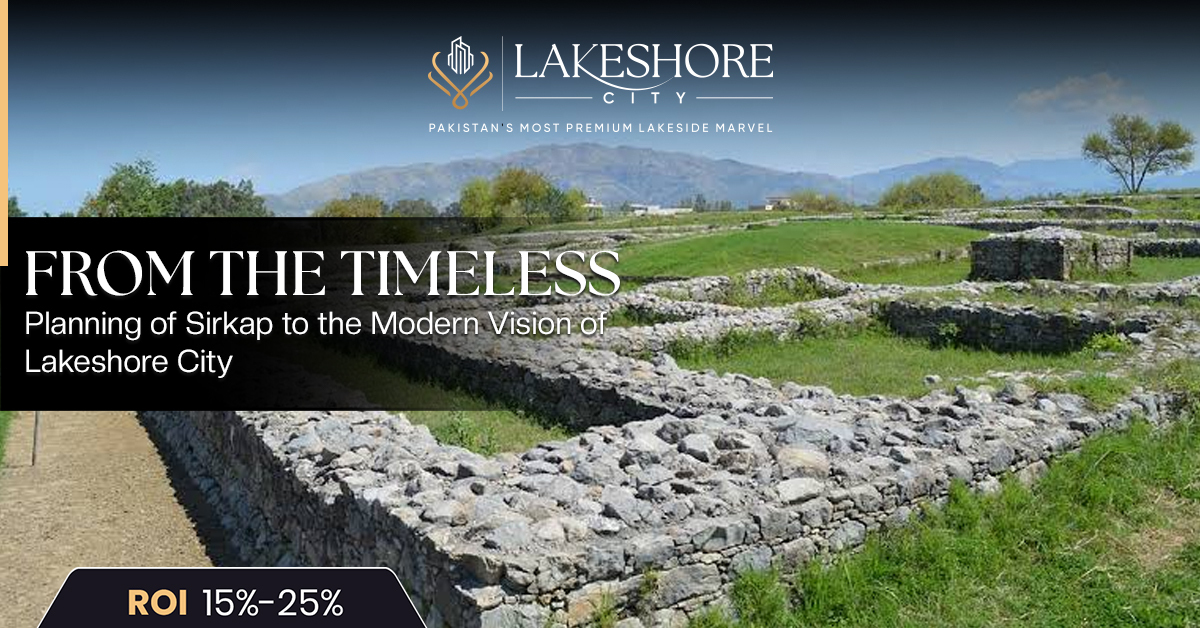
Twenty-two centuries ago, a Greek king stood on a riverbank in what is now Punjab and decided to build a city that would outlast his own dynasty. He got his wish, just not in the way he expected. Demetrius I’s kingdom is a footnote in most history books. His city, Sirkap, is a UNESCO World Heritage Site that archaeologists still walk through, street by street.
Most cities don’t get that kind of afterlife. They get demolished, paved over, forgotten under newer construction. The ones that survive, even as ruins, tend to share one trait: someone planned them properly before the first brick went down. Sirkap is one of the clearest proofs of that idea anywhere in South Asia.
This isn’t a history lesson dressed up to sell real estate. It’s closer to the opposite. Lakeshore City, the master-planned development rising on the banks of Khanpur Dam near Islamabad, is being built on the same logic that made Sirkap work: grid discipline, mixed-use density, walkable blocks, and infrastructure that goes in before the people do. Understanding why a 2,200-year-old city still draws researchers and tourists tells you something useful about why a 2026 township might be worth your investment.
What Was Sirkap? A City Built by a Conqueror Who Understood Urban Design
Sirkap sits in the Taxila Valley, on the banks of the Tamra Nala, across from the modern city of Taxila in Punjab. It was the second of three major settlements built in that valley over roughly a thousand years, coming after the older, organically-grown Bhir Mound and before the Kushan-era city of Sirsukh that eventually replaced it.
Demetrius I, an Indo-Greek king, founded Sirkap around 180 BCE after conquering the region. He rebuilt it on what’s called a Hippodamian grid, the same planning principle used in classical Greek cities like Olynthus in Macedonia. King Menander later expanded the city further. The result was one of the rare urban centers in South Asia laid out with deliberate Hellenistic geometry rather than grown street by street over generations.
The city changed hands several times over the following centuries. Indo-Greeks gave way to Scythians, then Parthians. The Indo-Parthian king Gondophares ruled the region from Sirkap, and the city even shows up in a surviving Greek account: the philosopher Apollonius of Tyana is said to have visited Taxila and described it as comparable in scale to ancient Nineveh, with high defensive walls built in a distinctly Greek style.
By the time the Kushans built Sirsukh nearby in the 1st century CE, Sirkap’s importance had already started to fade. Trade routes shifted, and the city was eventually destroyed, likely in waves, with a significant earthquake forcing major rebuilding at one point in its later Parthian phase. What survived is now part of the larger Taxila archaeological site, inscribed on the UNESCO World Heritage list in 1980. UNESCO’s own listing describes Taxila as a record of successive influences from Persia, Greece, and Central Asia, layered into one location from the 5th century BCE through the 2nd century CE, with Sirkap’s ramparts dated specifically to the 2nd century BCE.
None of this is trivia for its own sake. It matters because Sirkap wasn’t an accident of geography or a slow accumulation of huts. It was designed, on purpose, by people who had a theory about how cities should work, and that theory turned out to be durable enough to study two thousand years later.
Why Sirkap Was Centuries Ahead of Its Time
The Grid That Organized Everything
Sirkap’s main avenue ran roughly 600 meters north to south and was about 4 meters wide. More than a dozen narrower streets crossed it at right angles, cutting the city into rectangular blocks of comparable size. It wasn’t a perfectly straight grid. Archaeological surveys note that the layout gets less regular toward the city’s southern end, but the underlying logic held throughout: streets meet at angles you can predict, blocks are a size you can build on, and you always know roughly where you are.
That sounds obvious until you compare it to cities that grew without a plan, where roads follow old footpaths and property lines and nothing lines up. A grid isn’t just tidy. It’s efficient to build on, easy to extend, and simple for strangers to navigate, which matters enormously in a city that was, by design, a meeting point for several cultures at once.
Defense Built Into the Design, Not Bolted On Afterward
The city wall ran for several kilometers around Sirkap’s perimeter, several meters thick and, in places, several meters high, with a fortified gate and guard tower positioned at the end of the main avenue. This wasn’t decoration. Taxila sat on a frontier between competing empires for most of its history, and the people building Sirkap knew it.
Markets Built Where the Traffic Already Was
Shops lined both sides of the main street. That’s a small detail with a big implication: commercial activity was placed where foot traffic was guaranteed, rather than scattered randomly through residential blocks. It’s the same instinct that puts a coffee shop on a corner today instead of in the middle of a quiet street.
Housing That Mixed Privacy With Community
Private homes in Sirkap were built from rubble masonry, plastered with lime or mud, organized around small internal courtyards, with a second floor and a flat roof. One excavated house covered more than 2,000 square meters, evidence that the city accommodated a real range of household sizes and wealth levels, not a single uniform housing type.
A City That Rebuilt Smarter After Disaster
After a major earthquake during the Parthian period, many houses were reconstructed with stronger walls and deeper foundations. Some accounts of the later city describe height restrictions placed on new buildings as a direct safety response. That’s disaster-resilient planning, applied roughly two thousand years before “resilient infrastructure” became a phrase city planners put in grant applications.
Religious Pluralism, Expressed in Stone
Sirkap’s excavated remains include Buddhist stupas, a Jain temple, a Hindu sun temple, and an apsidal temple that blends Greek architectural form with local religious content. It’s physical proof of the Gandharan cultural synthesis the region became known for. Multiple faiths operated within the same walls, on the same streets, without one being designed to dominate the skyline over the others.
Sirkap didn’t survive because it was beautiful. It survived because it was buildable, defensible, and flexible enough to hold half a dozen cultures inside one wall.
| Key Takeaways: Sirkap at a Glance Founded around 180 BCE by the Indo-Greek king Demetrius I on a Hippodamian (Greek grid) planMain avenue ran about 600 meters, crossed by more than a dozen perpendicular streetsEnclosed by several kilometers of defensive wall with a guarded main gateShops concentrated along the primary avenue; housing ranged from modest courtyard homes to estates over 2,000 square metersPost-earthquake rebuilding used stronger foundations and height-restricted constructionBuddhist, Jain, Hindu, and Hellenistic religious sites coexisted within the same cityPart of the Taxila UNESCO World Heritage Site since 1980 |
Lessons Modern Cities Can Learn From Sirkap
Strip away the togas and the Greek inscriptions, and Sirkap’s planning logic reduces to a handful of principles that any urban planner today would recognize immediately.
Plan the grid before you plan the buildings. Sirkap’s streets came first; the architecture filled in around them. Reverse that order, as many unplanned settlements do, and you get exactly the chaos Sirkap avoided: narrow lanes, blocked access, utilities that have to be retrofitted around obstacles nobody anticipated.
Put commerce where people already walk. A market street works because it intercepts existing movement. Scatter shops randomly and you force people to go looking for them. Sirkap solved this by lining its busiest road with retail, a pattern modern mixed-use zoning is still trying to recreate in cities that zoned commercial and residential apart by accident decades ago.
Defense and safety aren’t optional extras. Sirkap’s walls, gates, and post-earthquake rebuilding all point to the same thing: a city that takes security and structural safety seriously from day one, rather than patching it in after a crisis, tends to last longer.
Diversity needs deliberate space, not just tolerance. Sirkap didn’t merely permit different religious communities to exist. It built dedicated space for each of them inside a single urban fabric. That’s a planning decision, not an accident of demographics.
A flexible block size accommodates a flexible population. Houses ranging from compact courtyard homes to 2,000-square-meter estates lived inside the same grid. The grid didn’t dictate one type of life; it gave structure flexible enough to hold many kinds of lives at once.
These are not ancient curiosities. They are, almost word for word, the design briefs that modern master-planned communities are built against today.
Introducing Lakeshore City: A Modern Master Plan on the Banks of Khanpur Dam
Lakeshore City sits on the shores of Khanpur Dam, a short drive from Islamabad: close enough for a daily commute, far enough to feel like an escape from the capital’s density. The project has secured NOC approval for 14,000 kanals of land from the Tehsil Municipal Administration, under NOC number 145-50, putting the development on documented regulatory footing rather than informal promises.
The philosophy driving the master plan isn’t far from what drove Sirkap’s builders: lay out the grid, the access roads, and the zoning logic first, then let the lifestyle infrastructure (clubs, schools, hospitals, retail) fill in around a structure that was designed to support it from the start, instead of growing around whatever happened to get built first.
Lakeshore is organized into distinct components rather than one undifferentiated sprawl of housing. Lakeshore Residencia is the core residential offering, with plot sizes running from 5 Marla up through 1 Kanal for residential use, and 4 to 8 Marla for commercial plots, alongside studio, one-bedroom, and two-bedroom apartment options. Lakeshore Farms offers larger farmhouse plots, in 2, 4, and 8 Kanal sizes, for buyers who want more land and a slower pace. Lakeshore Club functions as the lifestyle and amenity hub, with membership tiers (Bronze, Silver, Gold, and Platinum) that scale with the resident’s stake in the community.
Within Residencia’s planned amenity list: a dedicated educational sector, hospitals, restaurants, an event marquee and conference facilities, and a Cinepax cinema, the same mixed-use logic that put Sirkap’s shops on its main street, just updated for 2026 lifestyle expectations. The wider master plan also lists 5G-ready smart infrastructure and wildlife preservation zones among its planned features, positioning the project at the intersection of modern connectivity and the natural lake-and-mountain setting it’s built around.
→ Discover Lakeshore Residencia
How Lakeshore City Reflects Ancient Planning Principles
The comparison between a Hellenistic frontier city and a 21st-century lakeside township isn’t a stretch once you line up what each one was actually trying to solve.
| Planning Element | Sirkap (c. 180 BCE) | Lakeshore City (Today) |
|---|---|---|
| Street Layout | Hippodamian grid; ~600m main avenue crossed by perpendicular streets | Structured road network connecting residential, commercial, and recreational zones |
| Commercial Placement | Shops concentrated along the main avenue | Retail, dining, and event space integrated within Residencia and the Club |
| Defense / Security | Several kilometers of city wall, guarded main gate | Gated community structure with controlled access |
| Residential Variety | Courtyard homes to estates exceeding 2,000 sq. meters | Plot sizes from 5 Marla to 1 Kanal, plus 2–8 Kanal farmhouses and apartments |
| Religious / Cultural Space | Buddhist, Jain, Hindu, and Hellenistic sites within one city | Community and event spaces designed for a mixed, modern resident base |
| Disaster Response | Post-earthquake rebuilding with deeper foundations | Modern construction codes and planned infrastructure from inception |
| Natural Setting | Built on the Tamra Nala riverbank | Built on the shores of Khanpur Dam |
| Regulatory Standing | Recognized as a UNESCO World Heritage Site (1980) | NOC-approved (No. 145-50) for 14,000 kanals |
The differences are obvious. One city was built with rubble masonry and lime plaster, the other with reinforced concrete and 5G infrastructure. But the underlying decisions are the same family of decisions: define the grid, place commerce on the routes people will actually use, build security into the layout rather than around it, and leave room for more than one kind of household to live well inside the same community.
The principles that made Sirkap functional twenty-two centuries ago, structured streets, integrated commerce, defensible boundaries, and room for a mixed population, are still the test every master-planned community has to pass today.
Why Planned Communities Are the Future
Pakistan’s urban population has been climbing for decades, and Islamabad’s surrounding districts have absorbed a large share of that growth. Unplanned expansion creates the same problems it always has: roads that can’t handle the traffic they get, drainage systems improvised after flooding rather than designed before it, and commercial activity that clusters wherever it can instead of where it makes sense.
Planned communities exist specifically to avoid that pattern. A development with an approved master plan, documented NOC status, and zoned land use is solving the same structural problem Sirkap’s builders solved, just with modern tools. Climate resilience, smart-city infrastructure, and walkable, mixed-use design aren’t trends invented by marketing departments. They’re the same underlying response that planned cities have produced for thousands of years whenever growth outpaces ad hoc development.
For buyers, that translates into something concrete: a documented land title process, infrastructure that’s designed in advance rather than retrofitted, and a community structure that’s built to function as a whole rather than as a collection of disconnected plots.
| What makes a planned community different from a regular housing scheme? A planned community has an approved master plan and documented NOC status before construction begins, with roads, zoning, and infrastructure designed in advance rather than added after the fact. |
Benefits of Investing in Lakeshore City
Documented regulatory standing. NOC approval (No. 145-50) for 14,000 kanals, gives the project a paper trail buyers can verify rather than take on faith.
A real range of entry points. Whether the goal is a 5 Marla residential plot, a 1 Kanal estate, a commercial unit, or a multi-Kanal farmhouse, Lakeshore’s product range spans buyers with very different budgets and very different goals.
A flexible payment structure. Residencia’s current offering includes installment plans without down payment, booking charges, confirmation charges, balloting charges, possession charges, or half-yearly charges, a structure designed to lower the upfront barrier to entry. Buyers should confirm current terms directly, since payment structures in any active development are subject to revision over time.
Lifestyle infrastructure built around the lake. The Lakeshore Club’s membership tiers, reciprocal arrangements with national and international clubs, and amenities planned around boating, recreation, and event space are part of what separates a planned township from a plain subdivision.
Location logic. Sitting roughly 20 to 25 minutes from Islamabad’s D-12 sector and the Sikandar-e-Azam Road corridor, Lakeshore is positioned for residents who want proximity to the capital without living inside its density.
Long-term value potential, with the right caveats. Real estate near a developing capital-adjacent corridor has historically attracted investor interest, and a documented master plan typically supports more durable value than informal land schemes. That said, no real estate investment carries a guaranteed return, and property values are subject to market conditions, regulatory changes, and development timelines that can shift. Anyone evaluating Lakeshore as an investment, rather than a home, should treat appreciation as a possibility to research independently, not a promise made in this article.
Register now to book your plot or contact us for a site visit.
Final Thoughts
Sirkap didn’t survive because anyone tried to make it last forever. It survived because the people who built it solved real problems, movement, commerce, defense, coexistence, with a structure disciplined enough to hold up under a few thousand years of earthquakes, invasions, and changing rulers.
That’s the actual lesson here, and it has nothing to do with nostalgia. Cities and communities that get the bones right, the grid, the zoning, the access, the documentation, tend to outlast the ones that don’t. Lakeshore City isn’t claiming to be the next UNESCO site. It’s claiming something more modest and more useful: that building on a dam-side plot with an approved master plan, documented NOC status, and a deliberate mix of housing and amenities gives a community a better shot at lasting than building without any of that.
Sirkap’s planners never got to see what their grid would become two thousand years later. The people buying into Lakeshore City today get something Sirkap’s first residents didn’t: the chance to evaluate the plan before committing to it.
Frequently Asked Questions
What is Sirkap, and why is it historically important?
Sirkap is an ancient city in the Taxila Valley, founded around 180 BCE by the Indo-Greek king Demetrius I on a Greek-style grid plan. It’s historically significant as one of the few cities in South Asia built on deliberate Hellenistic urban design, and it’s part of the Taxila UNESCO World Heritage Site.
Who built Sirkap?
Sirkap was founded by Demetrius I, an Indo-Greek king, after his conquest of the Taxila region around 180 BCE. The city was later expanded under King Menander.
Is Sirkap part of Taxila?
Yes. Sirkap is the second of three major historical settlements in the Taxila Valley, following Bhir Mound and preceding the later Kushan-era city of Sirsukh. All three sites fall within the Taxila UNESCO World Heritage designation.
What made Sirkap’s urban planning unique for its time?
Sirkap used a Hippodamian grid, straight streets crossing at right angles, which was unusual in the region at the time. It combined this Greek planning method with local materials, religious sites from multiple traditions, and defensive walls suited to its frontier location.
Why did Sirkap eventually decline?
Sirkap’s prominence faded after the Kushans built the nearby city of Sirsukh in the 1st century CE, shifting trade and political focus. The city was ultimately destroyed, with archaeological evidence pointing to earthquake damage and later devastation during subsequent invasions.
Is Taxila a UNESCO World Heritage Site?
Yes. Taxila, including the Sirkap archaeological site, was inscribed on the UNESCO World Heritage list in 1980.
Where is Lakeshore City located?
Lakeshore City is located on the shores of Khanpur Dam, within driving distance of Islamabad, approximately 20 to 25 minutes from the Sikandar-e-Azam Road and Islamabad’s D-12 sector.
Has Lakeshore City received NOC approval?
Yes. Lakeshore Residencia has received NOC approval for 14,000 kanals of land, under NOC number 145-50. Buyers are encouraged to verify current documentation directly with the developer before finalizing any purchase.
What plot sizes are available at Lakeshore City?
Lakeshore Residencia offers residential plots in 5 Marla, 7 Marla, 10 Marla, and 1 Kanal sizes, plus 4, 6, and 8 Marla commercial plots. Lakeshore Farms offers larger farmhouse plots in 2, 4, and 8 Kanal sizes.
What apartment options does Lakeshore City offer?
Lakeshore Residencia includes studio apartments, one-bedroom apartments, and two-bedroom apartments alongside its plot-based offerings.
What amenities are planned at Lakeshore City?
Planned amenities include an educational sector, hospitals, restaurants, event and conference facilities, a Cinepax cinema, and Lakeshore Club access with recreational facilities centered on the dam.
What is Lakeshore Club, and how does membership work?
Lakeshore Club is the lifestyle and recreation hub of the development, offering Bronze, Silver, Gold, and Platinum membership tiers along with reciprocal access to partner clubs nationally and internationally.
Do Lakeshore Farms owners get club benefits?
Yes. Farmhouse owners receive a 50% discount on Lakeshore Club membership fees, along with complimentary boating and a guided experience, according to current published offers.
Is there a payment plan available, and does it require a down payment?
Lakeshore Residencia’s current structure is advertised with no down payment and no booking, confirmation, balloting, possession, or half-yearly charges. Specific terms should be confirmed directly with the sales team, as payment structures can be updated.
How does Lakeshore City compare to other housing societies near Islamabad?
Lakeshore differentiates itself through its dam-side location, tiered club membership system, and a documented NOC approval, all factors worth comparing directly against other developments in the region rather than taking on reputation alone.
Is investing in Lakeshore City a guaranteed way to grow my money?
No real estate investment offers a guaranteed return, and that includes Lakeshore City. Property values depend on market conditions, regional development, and timing, none of which can be predicted with certainty. Prospective buyers should research current market conditions and consult independent financial advice before investing.
How can I book a plot in Lakeshore City?
Plots can be reserved through the official Clients Booking Form, either online or by visiting the Lakeshore City office in Blue Area, Islamabad. The registration form is also available for buyers who want a sales representative to walk them through current options first.
What is the historical connection between Sirkap and Lakeshore City?
There’s no direct historical connection: different eras, different builders, different continents of influence. The link this article draws is conceptual. Both projects were shaped by deliberate master planning rather than organic, unplanned growth, and both prioritize structured streets, mixed-use design, and defensible, well-organized community layouts.
Why compare an ancient city to a modern housing project at all?
Because the underlying planning problems are the same ones cities have always faced: how to organize streets, place commerce, secure a perimeter, and house a mixed population well. Sirkap solved those problems with Greek geometry and rubble masonry. Lakeshore is solving the same category of problems with modern zoning, documented NOC approval, and contemporary infrastructure.