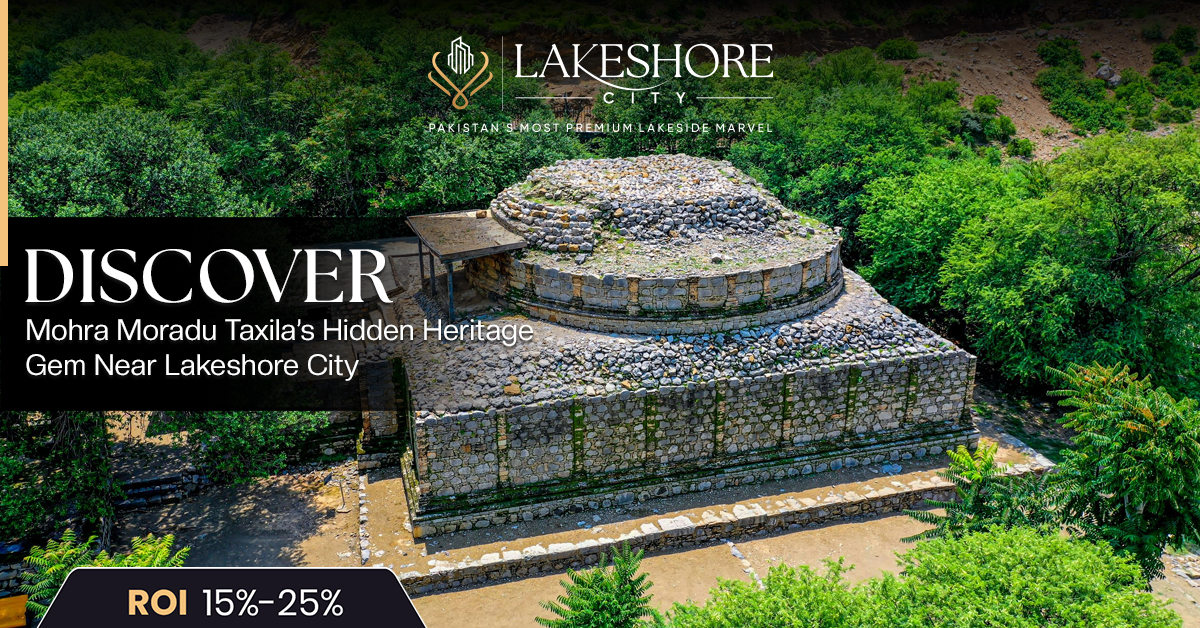
There’s a stretch of the Taxila valley where the wind still carries the quiet of a monastery abandoned centuries ago. Climb a short, unassuming path off the Grand Trunk Road and you’ll find it: rows of monks’ cells, a stupa court worn smooth by rain, and a silence that feels older than the stone itself. This is Mohra Moradu, one of the best-preserved Buddhist monasteries from the Gandhara civilization, and one of the least talked about.
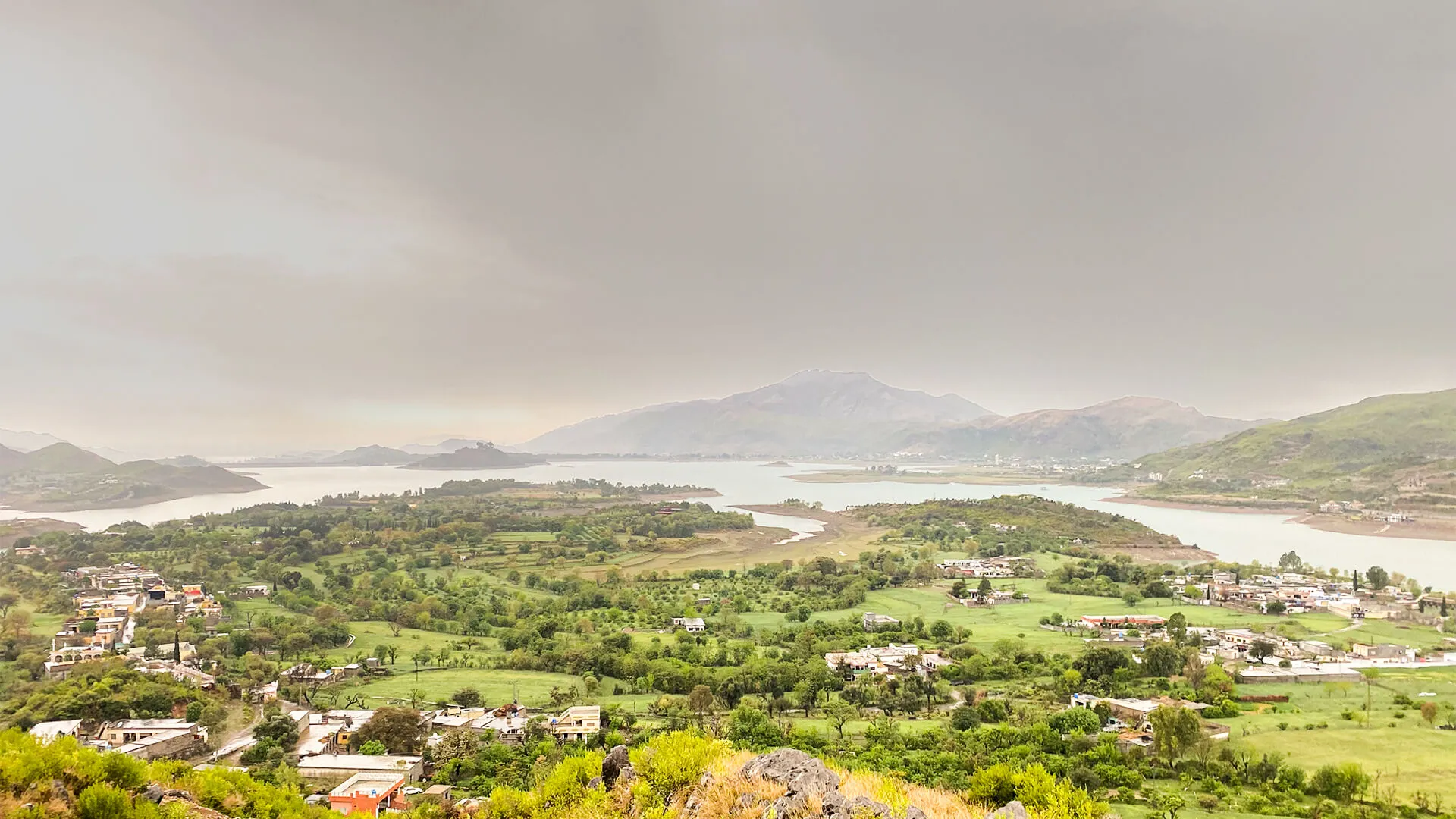
Most travelers heading to Taxila go straight for Jaulian or the Taxila Museum. Mohra Moradu gets missed, tucked slightly off the main circuit. That’s part of its charm. And for anyone living near this heritage corridor, that charm is close to home. Lakeshore City sits within reach of this exact landscape, where history isn’t a museum exhibit but a neighbor.
What Is Mohra Moradu?
Mohra Moradu is a Buddhist monastic complex dating to the Kushan period, roughly the 2nd to 5th century CE, when Gandhara stood as one of the great centers of Buddhist art and learning in South Asia. The site was uncovered during archaeological work in the early twentieth century, part of a broader excavation effort across the Taxila valley led by Sir John Marshall and the Archaeological Survey of India.
What makes Mohra Moradu stand out is its preservation. The monastery still shows a clear layout: a central stupa court surrounded by monks’ living quarters, with niches that once held stucco images of the Buddha. Several of these stucco figures survive in remarkably good condition, giving visitors a rare, direct look at Gandharan artistic technique, a style shaped by the meeting of Greek sculptural tradition and Buddhist iconography following Alexander’s campaigns and the region’s later Hellenistic influence.
The site forms part of the greater Taxila archaeological zone, inscribed as a UNESCO World Heritage Site in 1980 for its role in the development of Buddhist art and its significance as a hub of ancient learning along the trade routes connecting South Asia to Central Asia and the Mediterranean world.
Why Mohra Moradu Deserves More Recognition
Ask most visitors to Islamabad or Rawalpindi about Taxila, and they’ll mention Jaulian or the museum. Mohra Moradu rarely comes up, despite sitting close by and offering an experience that feels more personal, less crowded, and easier to absorb slowly.
Part of the reason is simple geography. The monastery sits slightly off the primary tourist path, requiring a short detour that many day-trip itineraries skip. But that same distance is what keeps it peaceful. There’s no pressure to move quickly through the site. Visitors can sit near the stupa court, study the stucco carvings up close, and take in the surrounding hills without competing for space.
Archaeologically, the site remains important for what it teaches about Buddhist monastic life: how monks organized their living spaces, how art served religious instruction, and how Gandharan craftsmen adapted foreign artistic influences into something distinct. For students, researchers, and curious travelers alike, Mohra Moradu offers a hands-on lesson in a civilization that shaped the region’s cultural identity long before modern borders existed.
Heritage Tourism Around Lakeshore City
Taxila’s archaeological zone is dense with sites worth visiting, and several sit within a short drive of Lakeshore City.
Jaulian Monastery, perched on a hilltop with sweeping valley views, is one of the best-known Buddhist sites in the region. Readers curious about its history can read our guide to Jaulian Monastery for a closer look at what makes it distinct from Mohra Moradu.
Sirkap, the ancient Greco-Bactrian city laid out on a grid plan, offers a different kind of history lesson, one rooted in urban design rather than monastic life. Our piece on Sirkap’s timeless planning explores how those ancient city principles echo in modern master-planned communities.
Taxila Museum houses one of the finest collections of Gandharan art in the country, including pieces recovered from Mohra Moradu itself, making it a natural stop before or after visiting the site.
Dharmarajika Stupa, believed to house relics associated with the Buddha, rounds out a heritage trail that few destinations in Pakistan can match for depth and accessibility.
Being situated near this corridor means residents of Lakeshore City aren’t just buying property. They’re settling into a region where world-class heritage tourism is part of everyday geography. Discover how Lakeshore City combines heritage with modern living, and see how proximity to these landmarks shapes the community’s identity.
Living Near History
There’s a difference between reading about history and living within walking distance of it. Weekend mornings can start with a family drive to Mohra Moradu instead of a crowded shopping mall. School projects on the Gandhara civilization become field trips rather than textbook exercises. Visiting relatives get an itinerary that few other cities in Pakistan can offer.
This kind of access shapes more than leisure time. It builds a sense of place, a connection to something larger than a single housing development. Children who grow up near Taxila’s ruins absorb a version of cultural literacy that’s hard to replicate anywhere else. For families weighing where to put down roots, that proximity carries real, lasting value.
Explore the premium lifestyle at Lakeshore Club to see how the community balances modern amenities with this rare cultural backdrop.
Why This Matters for Investors
Heritage tourism in the Taxila region has drawn steady interest from both domestic and international travelers, supported by ongoing conservation work and improved road infrastructure connecting Islamabad to the archaeological zone. This kind of sustained tourism interest tends to support long-term neighborhood appeal, though property values are shaped by many factors and past growth is not a guarantee of future performance.
For investors, the appeal isn’t a single number on a brochure. It’s the combination of infrastructure development, a growing tourism economy, and a lifestyle proposition that’s difficult for newer developments without historical context to replicate. As always, prospective buyers should treat any appreciation potential as one factor among several, not a guaranteed outcome, and should conduct their own due diligence.
Explore flexible payment plans designed for today’s investors, or book your consultation to walk through what this location offers in more detail.
Conclusion
Pakistan’s history doesn’t sit behind glass in this part of the country. It’s out in the hills, in stucco carvings that have survived seventeen centuries, in monastery courtyards where monks once studied under open sky. Mohra Moradu is a quiet reminder of how much depth this region holds, and how rare it is to build a home within reach of it.
Lakeshore City offers exactly that: a place where modern living sits alongside centuries of culture, where a weekend outing can mean standing where Gandharan monks once walked. Register today to receive the latest project updates, or learn more about Lakeshore Residencia to see how this heritage-rich address could become your next home.
FAQs
What is Mohra Moradu known for?
Mohra Moradu is known for being one of the best-preserved Buddhist monasteries in the Taxila valley, with intact stucco sculptures dating to the Kushan period.
Is Mohra Moradu part of a UNESCO World Heritage Site?
Yes. Mohra Moradu is part of the Taxila archaeological zone, inscribed as a UNESCO World Heritage Site in 1980.
How far is Mohra Moradu from Islamabad?
Mohra Moradu sits within Taxila, roughly a 30 to 40-minute drive from Islamabad, making it an accessible day trip.
What is the difference between Mohra Moradu and Jaulian Monastery?
Both are Buddhist monasteries from the same historical period, but Jaulian sits on a hilltop with panoramic views, while Mohra Moradu is smaller, quieter, and known for its unusually well-preserved stucco figures.
Why is Lakeshore City connected to Taxila’s heritage sites?
Lakeshore City is located near the Taxila heritage corridor, placing residents within easy reach of Mohra Moradu, Jaulian, Sirkap, and the Taxila Museum.