
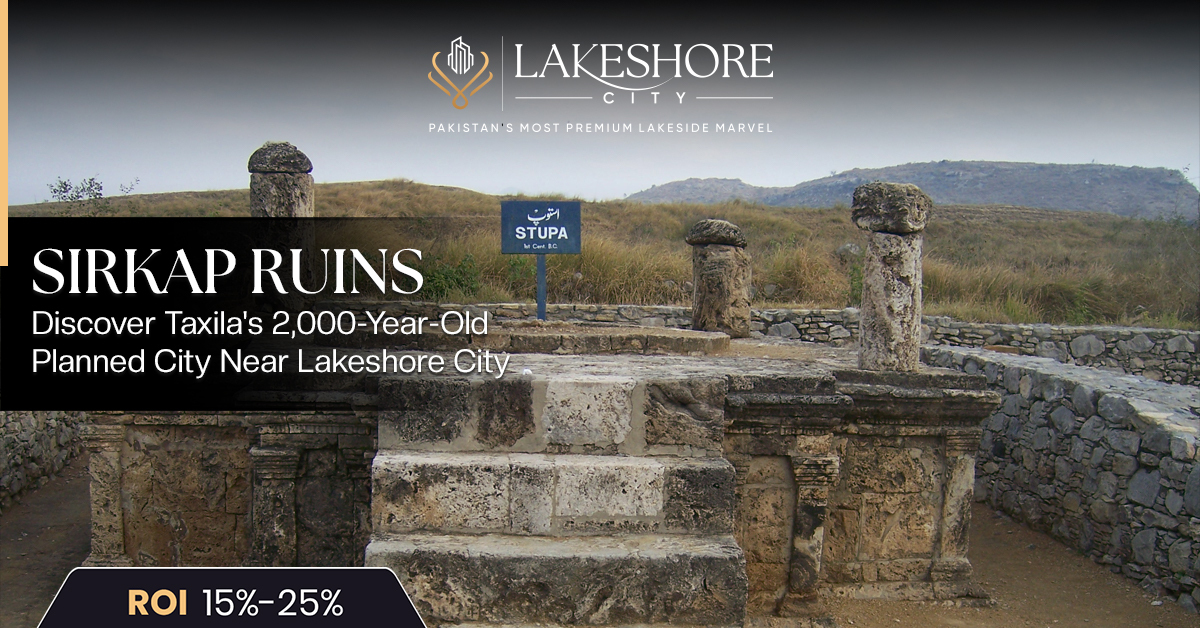
- Sirkap is a 2nd-century BCE Indo-Greek city near Taxila, built on a grid layout that makes it one of South Asia’s earliest examples of planned urban design.
- It forms part of the Taxila UNESCO World Heritage Site, inscribed in 1980.
- Lakeshore City sits within the same Taxila–Khanpur heritage corridor, making Sirkap an easy day trip from the community.
Most cities eventually disappear, worn down by war, flood, or simple neglect. What survives less often is the idea behind a city; the logic that decides where a street should run or where a market should sit. At Sirkap, on the outskirts of Taxila, that logic is still visible in the ground. Walk its exposed foundations today and you are tracing a street grid laid out roughly 2,200 years ago, one of the earliest deliberate exercises in urban planning found anywhere in South Asia.
Sirkap is not a single ruin but the remains of an entire city: a fortified settlement built by Indo-Greek rulers and later expanded under the Scythians and Parthians, standing as one of the defining sites within the Taxila valley’s dense archaeological landscape.
What Are the Sirkap Ruins?
Sirkap was founded in the 2nd century BCE, most likely under the Indo-Greek king Demetrius, and later remodeled under Menander I. It replaced Bhir Mound, an earlier and more loosely organized settlement nearby, as the region’s principal city. Where Bhir Mound grew organically, Sirkap was designed on a grid, its main street running north to south for roughly 600 metres, crossed by narrower side lanes at regular intervals, closer in spirit to a modern city block layout than to the winding lanes typical of ancient South Asian towns.
The city sat within the broader Gandhara civilization, a region shaped by successive waves of Persian, Greek, Scythian, Parthian, and Kushan influence between roughly the 5th century BCE and the 5th century CE. That layering of cultures shows up directly in Sirkap’s remains: temple foundations reflecting Greek, Buddhist, and local traditions sit within a few hundred metres of one another.
Sirkap forms part of the Taxila archaeological zone, inscribed as a UNESCO World Heritage Site in 1980 for its role in illustrating the evolution of urban civilization and Buddhist learning along the ancient trade routes connecting South Asia, Central Asia, and the Mediterranean world. For archaeologists, Sirkap remains one of the clearest physical records of how planned urban design took hold in the subcontinent centuries before it became common practice.
| Did You Know? Sirkap’s main street was wide enough for wheeled carts to pass one another, and excavators found drainage channels built directly beneath it, an engineering detail rarely found in cities this old. |
Why Sirkap Is Famous
Sirkap’s reputation rests on three things: its city planning, its religious diversity, and the sheer range of cultures visible in one compact site.
- Grid-based planning: a rare, deliberate street layout for its era, replacing organic growth with intentional design.
- Layered influences: Greek civic architecture, Persian administrative traditions, and Buddhist religious structures all coexist within the same walls.
- Religious plurality: the city held Buddhist stupas, a Jain temple foundation, and shrines reflecting Zoroastrian and local traditions side by side.
- The Double-Headed Eagle Stupa: one of Sirkap’s best-known monuments, its base decorated with Greek, Buddhist, and local architectural motifs in a single structure.
- Marketplace and residential zones: excavated house foundations and shop fronts along the main street give a rare, tangible sense of everyday city life in antiquity.
That combination, structured city planning built to accommodate several religions and cultures at once, is what continues to draw historians, archaeologists, and heritage travelers back to Sirkap generation after generation.
| Feature | Sirkap | Typical Ancient City |
|---|---|---|
| Street Layout | Grid-based, planned in advance | Organic, grown over time |
| Founding Period | 2nd century BCE (Indo-Greek) | Varies widely |
| Religious Character | Buddhist, Greek, Zoroastrian influences coexisting | Usually single dominant tradition |
| UNESCO Status | Component of Taxila World Heritage Site (1980) | Not always inscribed |
Visiting Sirkap from Lakeshore City
Sirkap sits within the Taxila heritage corridor, the same stretch of Punjab that runs alongside Khanpur Dam and the Margalla foothills. Lakeshore City’s location within this corridor makes Sirkap an easy addition to a single day’s itinerary rather than a separate trip requiring its own planning.
Visitors exploring this route often pair Sirkap with nearby Gandhara sites already covered in this heritage series, including Pippala Stupa, Jandial Temple, and Mohra Moradu, each a short drive from the others along well-maintained roads connecting Taxila to Haripur and Khanpur.
A typical day trip might begin at the Taxila Museum, move on to Sirkap’s grid streets and the Double-Headed Eagle Stupa, then continue toward the Buddhist monasteries scattered across the surrounding hills, before finishing with an afternoon by Khanpur Dam. For families, students, and overseas Pakistanis reconnecting with the region’s history, that combination of archaeology and open water in a single outing is difficult to replicate elsewhere near Islamabad.
Why Heritage Tourism Adds Value to the Lakeshore City Lifestyle
Living close to a UNESCO-listed landscape changes what an ordinary weekend can look like. A family outing can mean walking Sirkap’s ancient streets instead of a shopping trip. A school assignment on the Gandhara civilization becomes a field visit rather than a chapter to memorize. Visiting relatives get a genuine destination, not just a description of one.
Corridors situated near recognized heritage sites also tend to see steadier tourism-driven activity over time, as conservation work, museum upgrades, and improving road infrastructure draw a wider mix of domestic and international visitors. That pattern does not guarantee property appreciation; no location can promise that. But it does support a stronger long-term case for a residential community than a location with no cultural or recreational draw at all. Buyers should weigh this as one factor among several and conduct independent due diligence before making any investment decision.
Explore a lifestyle where history, nature, and modern living come together. Register today to discover how Lakeshore City connects you to Pakistan’s rich cultural heritage.
Conclusion
More than two thousand years after it was laid out, Sirkap still has something to teach: that a city can be shaped by intention rather than accident, and that different faiths and cultures can share the same streets without erasing one another. Historians and travelers keep returning to it for exactly that reason.
Lakeshore City sits within reach of this same corridor, offering modern waterfront living alongside one of Pakistan’s greatest historical treasures. Book your plot and enjoy living near some of the country’s most celebrated archaeological landmarks.
Frequently Asked Questions
What is Sirkap famous for?
Sirkap is famous for being one of South Asia’s earliest planned cities, built on a grid street layout under Indo-Greek rule in the 2nd century BCE, and for the religious diversity reflected in its temple and stupa remains.
Who built Sirkap?
Sirkap was founded by the Indo-Greek king Demetrius and later remodeled under Menander I, before continuing to develop under Scythian and Parthian rule.
Is Sirkap part of a UNESCO World Heritage Site?
Yes. Sirkap is one of the archaeological zones that make up the Taxila UNESCO World Heritage Site, inscribed in 1980.
How far is Sirkap from Islamabad?
Sirkap sits within Taxila, roughly 30 to 35 kilometers northwest of Islamabad, generally about an hour’s drive depending on traffic and route.
What can visitors see at Sirkap today?
Visitors can walk the exposed grid-plan streets, view house and shop foundations, and see monuments including the Double-Headed Eagle Stupa, which blends Greek, Buddhist, and local architectural motifs.
How is Sirkap connected to Lakeshore City?
Lakeshore City is located within the same Taxila–Khanpur heritage corridor as Sirkap, making it one of several UNESCO-listed sites accessible on a short drive from the community.
Can visiting Sirkap be combined with other Taxila sites in one day?
Yes. Sirkap is commonly paired with the Taxila Museum, Jandial Temple, Mohra Moradu, and Pippala Stupa, along with an afternoon at Khanpur Dam, as part of a single day-trip itinerary.