
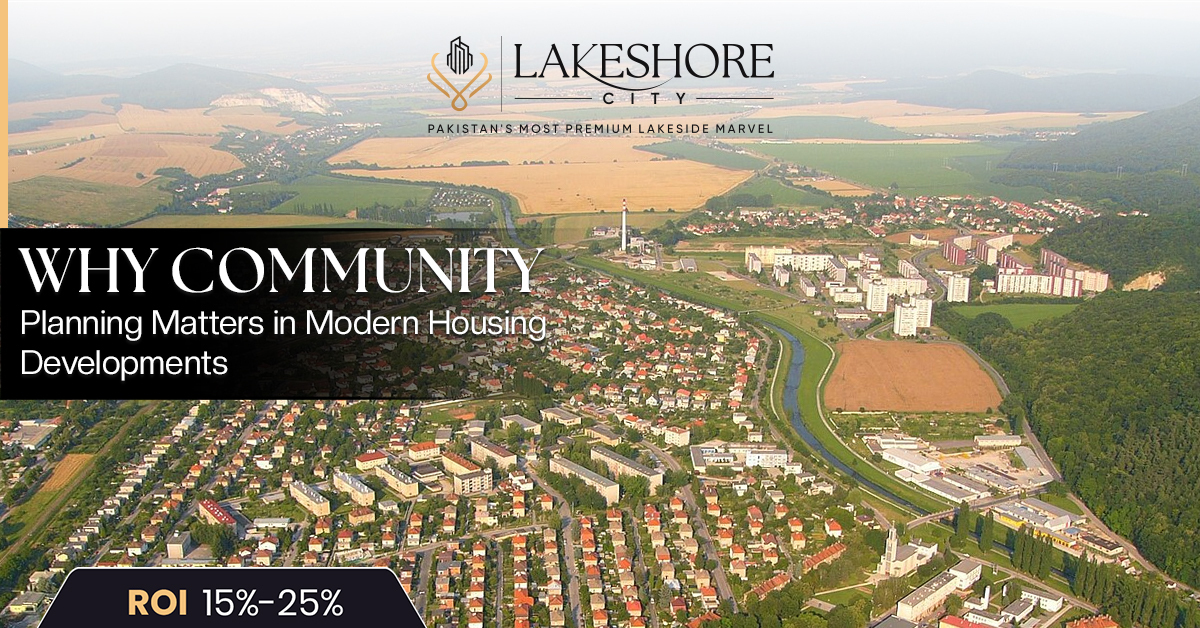
| Community planning matters because it determines how a housing development actually functions once people move in — how easily residents get around, how public and residential space relate to each other, and whether the surrounding infrastructure can support daily life, not just the individual plots being sold. |
A plot of land can be sold in an afternoon. A community takes years to plan properly — and the difference between the two shows up long after the paperwork is done. Anyone can subdivide land into residential blocks. Fewer developments actually think through how those blocks are supposed to function together once people are living in them.
What Is Community Planning in Real Estate?
Community planning is the process of deciding how land use, roads, residential zones, commercial areas, public spaces, and infrastructure fit together before construction begins. It’s the difference between a collection of individually sold plots and a development designed to work as a connected whole — where a resident can reasonably get from home to a main road, a shop, or open space without the layout getting in the way.
Why Does Community Planning Matter?
Good planning shows up in ways buyers often notice only after they’ve already moved in:
- Better organization — residential, commercial, and public areas don’t compete for the same space
- Improved accessibility — a road hierarchy that actually supports daily traffic, not just main entrances
- Efficient infrastructure — utilities and drainage designed for the development’s actual scale
- Better quality of life — less friction in everyday movement and errands
- Stronger community identity — a development that feels like a place, not just an address
- Long-term usability — layouts that still make sense as the area grows and matures
What Makes a Modern Housing Community Well Planned?
Buyers evaluating a housing development can look at a handful of concrete signals:
- Road hierarchy and connectivity between residential and main routes
- Residential layout — how plots and blocks are organized relative to each other
- Commercial planning — whether retail and services are placed sensibly, not as an afterthought
- Open and green spaces, where they genuinely exist in the plan
- Infrastructure maturity relative to the development’s current stage
- Accessibility to nearby cities and transport corridors
- A master plan with a logical sequence for future phases
Community Planning and Property Decisions
Price is usually the first thing buyers compare, but it’s an incomplete measure on its own. Two developments can list similar per-marla rates while offering very different levels of planning, infrastructure readiness, and long-term usability. Planning and infrastructure quality can influence how desirable a community becomes over time, though this depends on execution and should never be treated as a guarantee of appreciation or fixed returns. Buyers comparing options can review available payment options as part of that broader evaluation, alongside the development’s actual planning and progress.
Why Community Planning Matters for Families
For families specifically, planning translates into daily convenience: shorter, safer routes to schools and markets, a layout that doesn’t require long detours for basic errands, and a neighborhood environment shaped by more than just proximity of houses to each other. A well-planned development should make everyday living easier, not simply provide a place to own property.
Lakeshore City and the Idea of Planned Community Living
Lakeshore City is positioned within the broader heritage-tourism and real estate corridor near Khanpur Dam and Taxila, an area where connectivity and land-use planning matter as much as the individual plots on offer. As with any development in this category, the value of the project depends on how its planning translates into an actual, functioning community over time — something buyers should evaluate directly rather than assume. Readers who want to look further into the project can register their interest to receive current, verified project information.
What Should Buyers Check Before Choosing a Housing Development?
A property is not experienced in isolation; it’s experienced within its surroundings. Before committing to any housing development, it’s worth checking the following:
| Check | Why It Matters |
| Location | Determines daily accessibility and long-term convenience |
| Legal / regulatory documentation | Confirms the land and project are properly recorded and approved |
| Development status | Shows what’s actually built versus what’s still planned |
| Infrastructure | Roads, drainage, and utilities affect livability from day one |
| Master plan | Shows how residential, commercial, and open spaces are meant to work together |
| Accessibility | Affects commuting, deliveries, and connection to nearby cities |
| Payment obligations | Should be clearly understood before any commitment is made |
| Long-term personal needs | A development should fit your life five to ten years out, not just today |
Frequently Asked Questions
What is community planning in a housing development?
It’s the coordinated design of roads, residential zones, commercial areas, and infrastructure so a development functions as a connected community rather than a set of isolated plots.
Why is infrastructure important in a planned community?
Infrastructure — roads, drainage, utilities — determines whether daily life in a development runs smoothly from the outset or creates ongoing friction for residents.
How does community planning benefit families?
It shapes everyday convenience: safer, shorter routes to schools and markets, and a neighborhood environment built around how families actually move through their day.
What should buyers check before investing in a housing development?
Location, legal documentation, development status, infrastructure, the master plan, accessibility, and payment obligations, weighed against personal long-term needs.
Smart buyers evaluate not only what they’re buying today, but how the surrounding community is planned to function years from now. For those ready to move forward, the next step is to explore the booking process directly with the Lakeshore City team.