
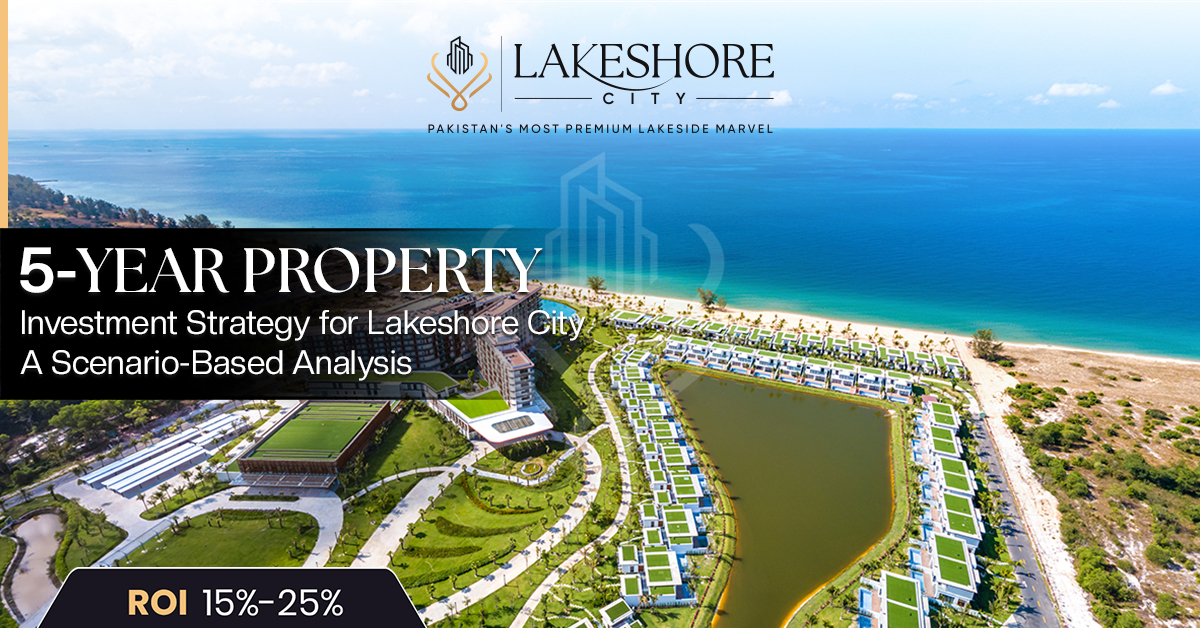
A five-year window is long enough to matter in real estate and short enough to plan around. It gives infrastructure time to progress, gives a residential area time to mature, and gives an investor a realistic point at which to reassess rather than react to short-term noise. For anyone evaluating Lakeshore City, that horizon is a useful lens: it separates what is happening now from what could plausibly happen next, without pretending to know exactly how it will unfold.
Is Lakeshore City suitable for a 5-year property investment strategy? For investors who are comfortable with a mid-term horizon and realistic expectations, Lakeshore City’s development around the Khanpur Dam and Taxila corridor offers a plausible growth story. It is not a guaranteed outcome, and it should be evaluated through scenarios rather than fixed predictions.
Why Use a 5-Year Investment Horizon?
Property markets rarely move in a straight line. A location can be quiet for a year or two, then see a burst of activity once roads, utilities, or anchor amenities reach a usable stage. A one- or two-year view often captures only part of that cycle, which is why many analysts treat five years as a more realistic minimum for judging whether a location’s fundamentals are actually developing, rather than judging short-term price movement alone.
Five years also gives an investor room to plan for holding costs, monitor development progress firsthand, and adjust their position if circumstances change — something a shorter, more speculative timeline does not allow for.
Lakeshore City Investment Outlook
Lakeshore City sits within the Khanpur Dam and Taxila corridor, an area that combines heritage tourism appeal with residential development. This dual identity is part of what makes the location worth analyzing over a multi-year horizon: tourism-linked footfall and residential growth do not always move at the same pace, and an investor benefits from understanding both drivers rather than treating the area as a single-purpose market.
Any claim about future appreciation in this corridor should be treated as an informed expectation rather than a fact. Development progress, tourism activity, and regional infrastructure all influence outcomes, and none of them move on a fixed schedule.
Three 5-Year Investment Scenarios
The following scenarios are structured to help investors reason through different outcomes. They are illustrative frameworks based on reasonable assumptions, not predictions or guarantees.
Conservative Scenario
In this scenario, development and demand grow more slowly than expected. Infrastructure work progresses in stages rather than on a fast timeline, and broader market conditions stay flat or soft. An investor approaching this scenario defensively would treat the property as a long-hold asset, avoid relying on short-term resale, keep enough liquidity to cover holding costs without pressure, and reassess the position periodically rather than assuming steady appreciation.
Base-Case Scenario
This scenario assumes moderate, steady progress — infrastructure and amenities develop in line with typical project timelines, residential interest grows gradually as the area becomes more livable, and market conditions remain broadly stable. This is the scenario most consistent with how planned developments in similar corridors have historically progressed, and it supports a reasonable investment thesis without assuming exceptional performance.
Optimistic Scenario
This scenario assumes stronger-than-expected infrastructure delivery, faster residential uptake, and favorable broader market conditions. It represents an upside case, not an expectation. If tourism activity around Khanpur Dam strengthens alongside faster development milestones, demand and values could respond more quickly than the base case suggests — but this scenario should be treated as a possibility to plan around, not a target to bank on.
| Factor | Conservative | Base-Case | Optimistic |
| Development pace | Slower / staged | In line with typical timelines | Faster than expected |
| Demand growth | Flat to gradual | Steady, gradual increase | Accelerated uptake |
| Investor posture | Defensive, long-hold | Balanced, patient | Opportunistic, still cautious |
Key Factors Investors Should Monitor
Regardless of which scenario plays out, a few factors are worth tracking directly rather than assuming: infrastructure and road development within and around the corridor, accessibility to Islamabad and surrounding areas, visible residential uptake and livability improvements, and the broader supply-demand balance in comparable developments nearby. These are observable signals an investor can check periodically, rather than figures that can be predicted in advance.
Risks to Consider Before Investing
Every multi-year real estate position carries risk, and Lakeshore City is no exception. Development timelines can shift due to factors outside any single developer’s control. Broader economic conditions, interest rates, and construction costs can affect both development pace and buyer demand. Liquidity is also a factor — properties in developing corridors are not always easy to resell quickly, which is why a five-year strategy generally suits investors prepared to hold through both quiet and active periods rather than needing a fast exit.
Who May Suit This Investment Strategy?
This approach tends to suit investors who can commit capital for a multi-year period without needing near-term liquidity, who are comfortable evaluating a developing corridor rather than an already-mature one, and who want to weigh realistic scenarios instead of relying on guaranteed-return promises. It is less suited to investors who need quick turnover or who are unwilling to monitor development progress over time.
Final Takeaway
A 5-year property investment strategy for Lakeshore City is best approached through scenarios rather than certainty. The conservative, base-case, and optimistic outlooks outlined above are reasoning tools, not forecasts — the actual path will depend on how infrastructure, demand, and broader market conditions unfold over the coming years. Investors who research the corridor directly, track the factors that matter, and size their position around a defensive scenario tend to be better positioned regardless of which outcome materializes.
Serious investors considering this corridor are better placed after reviewing current project details and speaking directly with the Lakeshore City sales team, who can confirm the latest development status and available inventory.
Frequently Asked Questions
Is Lakeshore City a good investment for a 5-year horizon?
It can suit investors comfortable with a mid-term timeline and realistic expectations. Outcomes depend on infrastructure progress, demand growth, and market conditions, and should be evaluated through scenarios rather than guarantees.
What factors could affect Lakeshore City’s future property value?
Infrastructure and road development, accessibility, residential demand, tourism activity around Khanpur Dam, and broader market-cycle conditions are the main factors worth monitoring.
What is the difference between the conservative and optimistic scenarios?
The conservative scenario assumes slower development and demand growth, favoring a defensive, long-hold approach. The optimistic scenario assumes faster infrastructure delivery and stronger demand, representing a possible upside rather than an expected outcome.
Does a 5-year strategy guarantee returns in Lakeshore City?
No. Real estate outcomes are influenced by multiple factors outside any single investor’s control. A 5-year strategy is a planning framework, not a guarantee of appreciation or returns.