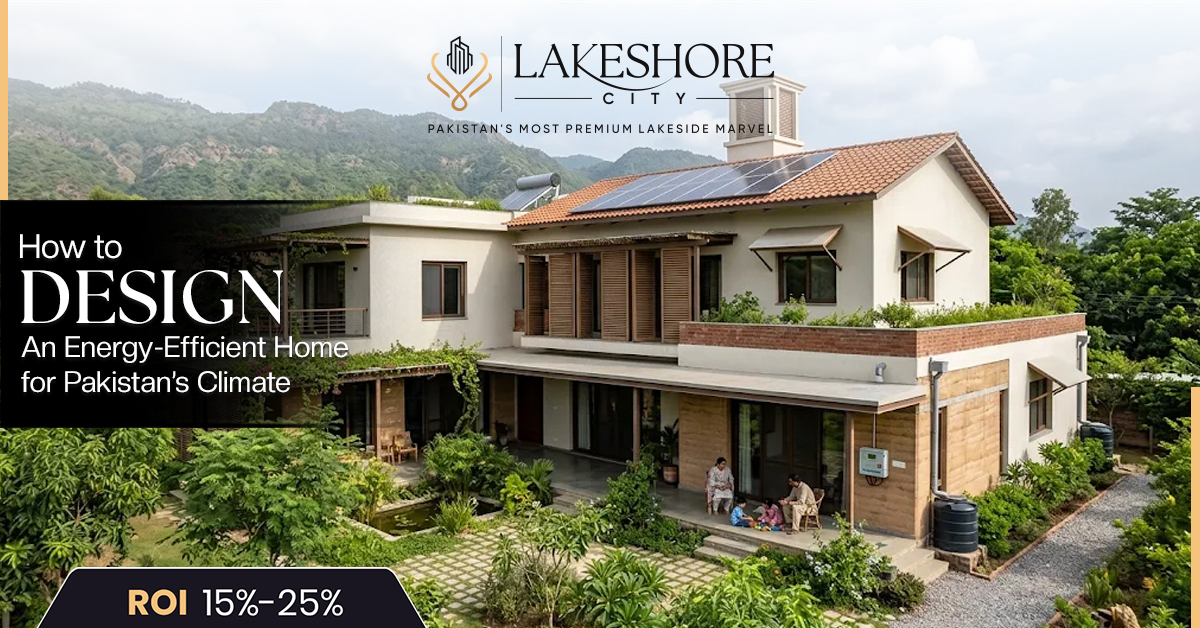
In Pakistan, building a home necessitates careful planning, particularly in light of the country’s harsh summer temperatures, seasonal weather variations, and escalating utility bills. A well-designed house should minimize its impact on the environment and energy use while providing comfort.
Renewable energy sources, natural ventilation, suitable insulation, and astute architectural design are all incorporated into energy-efficient homes in Pakistan. By implementing these features during construction, homeowners can save utility expenses and create long-term comfortable living spaces.
Understand Pakistan’s Climate
Pakistan has a diverse climate. Islamabad and Lahore have hot summers and cold winters, while Karachi has a humid coastal climate. Because of their colder winters, northern locations require additional insulation.
Climate-responsive home design considers sunlight, wind direction, humidity, and seasonal temperatures. Important considerations include:
- Positioning buildings to minimize afternoon heat.
- Planning windows for natural ventilation.
- Using suitable roof and wall insulation.
- Incorporating shaded outdoor spaces.
- Selecting climate-appropriate construction materials.
Priorities Passive Cooling and Cross Ventilation
Passive cooling uses natural airflow, shading, and architectural features to maintain appropriate interior temperatures without the need for on-air conditioning.
Cross ventilation allows fresh air to enter through one opening and warmer air to escape through another. Homeowners can improve airflow by:
- Installing windows on opposite or adjacent walls.
- Adding ventilators to release trapped heat.
- Designing open layouts where practical.
- Incorporating shaded balconies and courtyards.
These features can reduce cooling requirements when outdoor conditions are suitable.
Invest in Roof Insulation
Roofs are exposed to sunlight over extended periods of time, which greatly increases indoor heat gain. In order to maintain comfortable temperatures, proper insulation limits heat transfer.
Consider thermal insulation boards, light-colored roofing materials, reflective roof coatings, and insulated fake ceilings. Combining suitable insulation with waterproofing can also extend the longevity of a roof.
Plan Windows for Natural Lighting
Windows that are placed strategically let in natural light and lessen the need for artificial lighting. On the other hand, too much direct sunshine can raise the temperature inside.
For effective energy-saving house design:
- Position windows to maximize useful daylight.
- Install external shades and roof overhangs.
- Use suitable glazing to control heat gain.
- Incorporate curtains and blinds.
- Consider prevailing winds when planning openings.
Choose Energy-Efficient Construction Materials
Energy usage, building durability, and interior temperatures are all impacted by construction materials.
Suitable options include:
- AAC blocks: Offer useful thermal insulation properties.
- Cavity walls: Help reduce heat transfer through air gaps.
- Insulated wall systems: Improve indoor temperature control.
- Low-emissivity glass: Limits unwanted solar heat gain.
- Reflective roofing: Reduces solar heat absorption.
The local climate, structural specifications, and financial constraints all influence the choice of materials. Finding appropriate solutions might be aided by expert advice.
Consider Solar Panels and Backup Systems
Homes with solar power provide a chance to produce electricity and lessen reliance on traditional power sources.
Prior to installation, consider the solar panel size, roof orientation, inverter selection, and maintenance requirements. Battery storage can also be used as a backup in case of a power outage.
An appropriately sized system should take into account both the available installation space and the actual household electricity consumption.
Install Water-Efficient Plumbing
Another component of sustainable home design is water management. Effective showerheads, dual-flush toilets, low-flow taps, and leak-resistant plumbing can all reduce water waste.
Rainwater collecting and suitable greywater recycling technologies can improve water management even further when they are practical and permitted.
Incorporate Landscaping and Shade
Reducing direct sunlight exposure and enhancing outdoor comfort are two benefits of trees, plants, and shaded outdoor areas.
Think about establishing covered walks, installing pergolas, selecting native plants, and planting shade trees next to windows facing west.
For more insight, explore How Residential Communities Can Balance Development With Natural Landscapes.
Select Energy-Efficient Appliances
Electricity usage in homes can be decreased with the use of efficient appliances. Think of energy-efficient washing machines, LED lighting, energy-efficient freezers, and inverter air conditioners.
To encourage improved performance, choose appliances based on home needs and give them routine maintenance.
Balance Construction Costs and Long-Term Savings
Energy-efficient features can lower operating costs over time, but they may raise initial building costs.
| Feature | Potential benefit |
| Roof insulation | Reduced heat transfer |
| Efficient windows | Better thermal comfort |
| Solar panels | Lower grid electricity consumption |
| LED lighting | Reduced lighting costs |
| Water-efficient fixtures | Less water wastage |
The quality of the installation, household usage, electricity prices, and maintenance all affect actual savings.
For pertinent energy-efficiency recommendations, homeowners could also refer to Pakistan’s Energy Conservation Building Code (ECBC-2023), which was created by NEECA.
Lakeshore City and Modern Community Living
A home’s surroundings have an impact on how comfortable it is. A better quality of life is enhanced by green areas, recreational amenities, and well-planned residential areas.
Lakeshore City, which is close to Khanpur Dam, has residential and lifestyle developments, such as Lakeshore Residencia, Lakeshore Farmhouses, and Lakeshore Club.
Explore the Lakeshore City Master Plan and Features and Facilities to learn more about its planned residential environment.
Conclusion
It takes careful architectural planning, appropriate materials, and effective resource management to design an energy-efficient home in Pakistan. Water-saving fixtures, solar energy, insulation, and passive cooling can all lower household costs while increasing comfort.
Homeowners may design useful, cozy, and sustainable living areas by implementing these aspects during construction.
FAQ
1. What is climate-responsive home design in Pakistan?
In order to increase indoor comfort and lower energy usage, it takes into account local temperatures, sunlight, humidity, and wind patterns.
2. How do passive cooling and cross ventilation work?
Instead of depending solely on-air conditioning, they use shade and natural airflow to reduce internal heat and enhance ventilation.
3. How does roof insulation reduce heat?
It helps keep interior temperatures lower throughout the summer by slowing the flow of heat from the roof into living areas.
4. Where should windows be placed for natural lighting?
Windows should take into account the direction of the building and the predominant winds in order to optimize sunshine while limiting excessive direct sunlight.
5. Which construction materials are best for energy-efficient homes?
Thermal performance can be enhanced by AAC blocks, cavity walls, insulated wall systems, appropriate glass, and reflective roofs.
6. Are solar panels and backup systems suitable for Pakistani homes?
Indeed. Electricity is produced by solar panels, and in the event of a power outage, suitable battery systems can supply backup.
7. How can water-efficient plumbing reduce energy consumption?
It can cut down on the amount of electricity needed for heating and water pumps while also reducing water waste.
8. How does landscaping improve home energy efficiency?
Shaded outdoor areas and well-planted trees lessen exposure to direct sunshine and enhance outdoor comfort.
9. Which appliances should an energy-efficient home use?
Energy-efficient refrigerators, energy-efficient washing machines, LED lighting, and inverter air conditioners are also helpful options.
10. Is an energy-efficient home more expensive to construct?
While certain measures are more expensive at first, there may be long-term financial gains from using less water and electricity.