There is a question that almost every investor in Pakistan asks at some point — usually after buying a plot, watching nothing happen for a few months, and wondering if they made the right call.
How long does it actually take for property value to go up?
It is a fair question. And the honest answer is: it depends on where you buy, when you buy, and what is happening around that location. Near Islamabad, the story is particularly interesting right now — because the city is expanding, infrastructure is improving, and new corridors like the Khanpur Dam region are quietly becoming some of the most watched investment zones in the country.
If you are a first-time buyer, an overseas Pakistani weighing your options, or a middle-class family trying to build long-term wealth through property, this article is written for you. No jargon, no unrealistic promises — just a practical look at how property appreciation works in Pakistan and what you can realistically expect when you invest near Islamabad.
How Property Appreciation Actually Works in Pakistan
Before talking timelines, it helps to understand the basic mechanics of property value growth in the Pakistani market — because it works differently here than in, say, the UK or UAE.
In Pakistan, property appreciation rarely happens in a straight line. Values tend to jump in spurts — driven by a new road, an infrastructure announcement, a development approval, or simply a wave of investor confidence. Between those spurts, prices can stay flat for months or even years. This is completely normal and does not mean a project is performing badly.
The real estate cycle in Pakistan typically moves through four stages:
- Early entry — when a project launches and prices are at their lowest
- Development phase — when infrastructure work begins and investor interest picks up
- Maturity phase — when possession is near and genuine buyers (not just investors) start entering the market
- Peak demand — when the area has developed enough to attract permanent residents
The biggest returns almost always go to those who enter during the first or second stage. By the time a society is fully developed and well-known, the easy appreciation has already happened.
“In Pakistan’s property market, patience is not just a virtue — it is literally the strategy.”
What Drives Property Value Near Islamabad?
Islamabad has some of the most predictable real estate appreciation patterns in Pakistan — and the reason for that is largely structural. The city was always going to grow. The question was just which direction.
Over the past decade, two major corridors have seen consistent value growth: the Rawalpindi Ring Road zone and the southern Islamabad region stretching toward Taxila, Attock, and — more recently — the Khanpur Dam belt. Here is what is actually driving prices in these areas:
Infrastructure Development
Roads transform land values faster than almost anything else. When a new motorway, expressway, or arterial road connects a previously remote area to Islamabad, property prices in that zone can double within three to five years. The Havelian-Islamabad motorway extension, the CPEC route connectivity, and improvements to the M-1 corridor have all created ripple effects on surrounding land values.
Every serious investor watches road announcements the way a stock trader watches earnings reports.
Population Pressure and Housing Demand
Islamabad’s population has been growing steadily, and the city’s strict zoning laws make expansion inward almost impossible. The only direction is outward. Suburban and peri-urban areas — places that felt remote just five years ago — are now within commuting distance of the capital.
This population pressure does not slow down. It compounds. And compounding demand is exactly what drives long-term property appreciation.
Tourism and Natural Amenities
This is a factor that most real estate guides ignore, but it genuinely matters in the Islamabad region. Areas near Khanpur Dam, Murree, and the Margalla Hills have a built-in demand driver that purely urban plots do not — people want to live near natural beauty, not just work near it.
Societies positioned near recreational and natural landmarks attract a premium buyer profile: upper-middle-class families, non-resident Pakistanis, and professionals looking for a second home or peaceful primary residence. That profile means stronger demand and faster price appreciation.
Government Approval and NOC Status
In Pakistan, legal status is not just a technicality — it is a major price lever. An approved, NOC-compliant housing society typically commands a 20 to 40 percent premium over unapproved land nearby. And as approval processes tighten under PHATA, RDA, and CDA frameworks, compliant projects become scarcer and more valuable.
Islamabad Is Expanding — And the Direction Matters
For anyone serious about property investment near Islamabad, understanding the city’s growth direction is critical.
Islamabad is physically constrained on its northern and eastern edges by the Margalla Hills and Murree Hills. That means sustained expansion can only happen westward and southward — toward areas like Taxila, Wah Cantt, Hasan Abdal, and the Khanpur Dam region.
This is not speculation. It is visible in the data. Plot rates in areas along the Islamabad-Peshawar motorway corridor have risen sharply since 2018. The Rawalpindi Ring Road project — once complete — is expected to bring further appreciation to the western and southern zones.
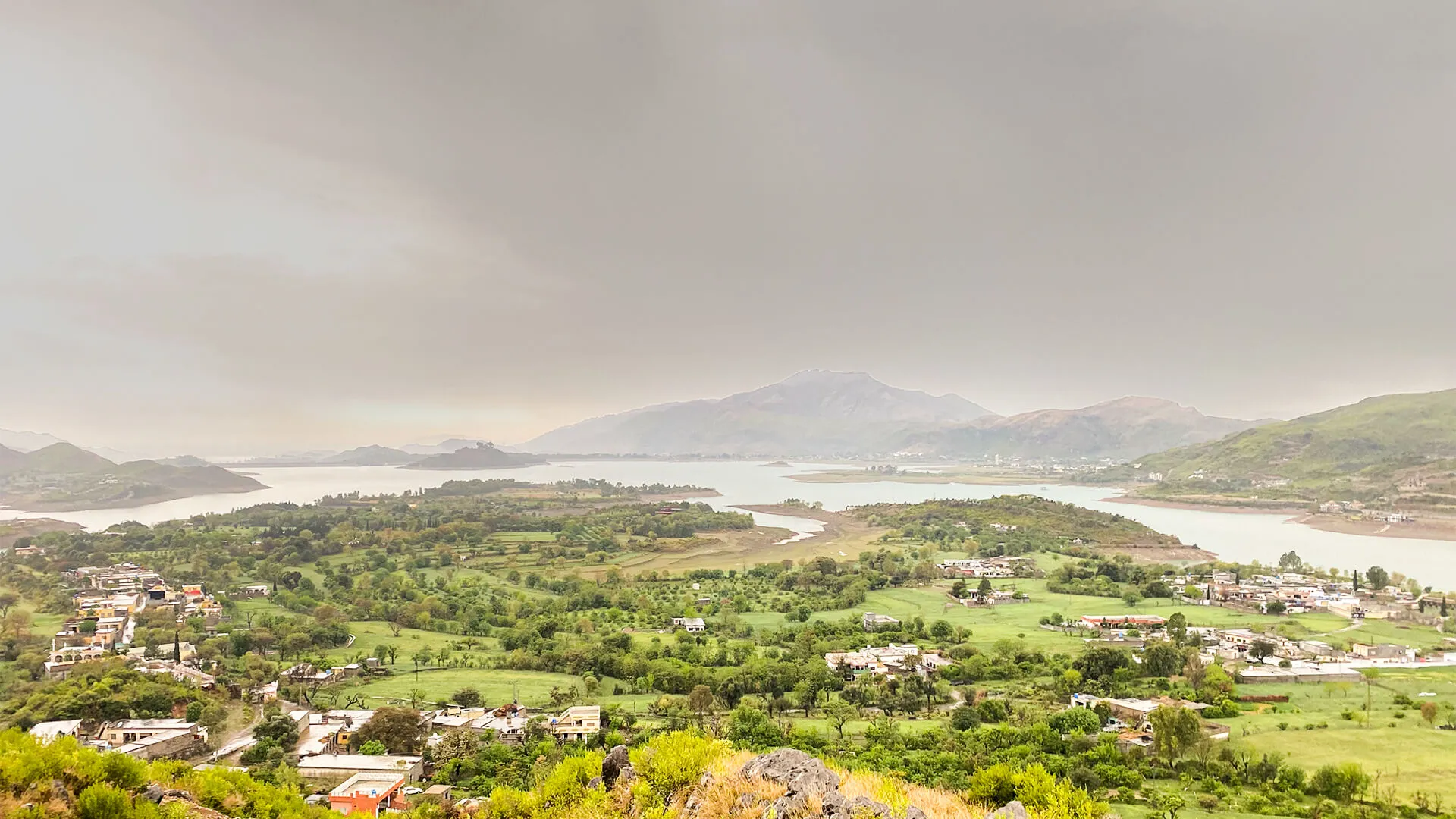
The Khanpur Dam area, in particular, has caught the attention of investors who do their homework. It sits at the confluence of several demand drivers: proximity to Islamabad (roughly 35–45 km), natural beauty, dam-based tourism activity, and relatively affordable land compared to what you find inside or immediately around the capital.
For context: a 5 marla plot in a regulated society inside Islamabad easily starts at PKR 70–80 lakh. In a well-planned society near Khanpur Dam, the entry point is a fraction of that — with the same long-term appreciation story unfolding over the next five to eight years.
Why Installment-Based Projects Are Attracting Serious Investors
One of the most significant shifts in Pakistan’s real estate landscape over the past few years is the growing appeal of installment-based housing societies — not just for middle-class families, but for sophisticated investors who understand the math.
Here is the logic:
- You put in 20–30% upfront, spread the rest over 3–5 years
- During those years, the plot appreciates — often by more than your remaining instalments
- By the time you complete payment, you may already be sitting on a profit
- Your total capital outlay is spread over time, reducing opportunity cost
This model particularly works when the developer is actively developing. If roads are being laid, utilities are being installed, and the community is taking physical shape — those are signs that your installment-based investment is backed by real work on the ground.
For overseas Pakistanis who cannot park large lump sums, instalments also provide a manageable way to invest in Pakistan real estate with low upfront capital. Many diaspora investors now treat a 5 marla plot on instalments near Islamabad as a standard part of their savings strategy — similar to a recurring investment but in tangible land.
Lakeshore City: A Case Study in Strategic Location
When looking at the fastest-growing housing societies near Islamabad, Lakeshore City near Khanpur Dam stands out for a specific reason — it is not just selling plots, it is selling a lifestyle in a location that checks most of the boxes serious investors look for.
The project is situated near Khanpur Dam, which gives it something rare in Pakistan’s housing market: a genuine natural amenity that drives demand independently of the developer’s marketing. People want to live near the dam. Families want weekend access to that environment. That organic demand is a price-support mechanism that purely urban societies simply do not have.
From an investment standpoint, a few things stand out about what Lakeshore City represents as an investment opportunity:
- Location in the Islamabad-Peshawar corridor, which has a documented track record of appreciation
- Proximity to Khanpur Dam — an active recreational destination that draws consistent visitor traffic
- Flexible payment plans that allow entry at affordable price points, including 5 marla options
- Development activity on the ground — not just brochures and promises
- Positioned to benefit from Islamabad’s westward expansion trajectory
For middle-class families in Pakistan looking for a first property investment, or overseas Pakistanis wanting something tangible back home, this kind of project represents a credible entry point into the Islamabad real estate market without the capital requirements of a DHA or Bahria-style investment.
Practical Tips Before You Invest in Property Near Islamabad
After all the analysis, here is the ground-level advice that actually matters:
1. Verify the NOC Before Anything Else
Do not let excitement override due diligence. Check the NOC status with the relevant authority — PHATA for Khyber Pakhtunkhwa areas, RDA for Rawalpindi-adjoining societies, CDA for Islamabad zones. An unapproved society is a gamble, not an investment.
2. Visit the Site in Person
Or send someone you trust. Development on the ground — even partial — is the most reliable signal that a project is real. Look for boundary walls, graded roads, utility trenching, or a working site office. If the land is completely undisturbed, understand what you are actually buying.
3. Think in Phases, Not Months
Property near Islamabad is a 5 to 8 year play, minimum, for meaningful returns. If you need liquidity in 12 to 18 months, real estate is probably not the right vehicle. But if you are investing for the medium to long term, the Islamabad corridor has historically rewarded patient investors consistently.
4. Compare Price Per Marla Across Projects
The absolute plot price matters less than the price per marla relative to what comparable areas have sold for historically. Do a quick comparison: what did similar plots in a similar growth-stage society sell for five years ago, and where are they now? That tells you more than any brochure will.
5. Diversify if You Can
If your budget allows, consider splitting between one plot in an established area (lower return, lower risk) and one in a developing area (higher return, higher risk). This is how experienced Pakistani investors typically approach the market — not all-in on one bet.
Frequently Asked Questions
How long does property value take to increase near Islamabad?
Typically, 3 to 7 years for meaningful appreciation in developing societies near Islamabad. Early-stage projects can show 15–35% gains within the first 2–3 years if active development is underway. Full maturity and peak value usually takes 7 to 10 years.
Which areas near Islamabad have the highest property appreciation?
Historically, the Rawalpindi Ring Road corridor, the Islamabad-Peshawar motorway belt (including areas near Taxila and Hasan Abdal), and more recently the Khanpur Dam region have shown strong appreciation. Areas benefiting from new road connectivity tend to perform best.
Is Khanpur Dam property a good investment in 2025?
For patient investors with a 5 to 8 year horizon, yes. The area benefits from proximity to Islamabad, natural tourism demand, and relatively affordable entry prices. As Islamabad expands westward, demand for well-located housing in that corridor should continue to grow.
Can overseas Pakistanis invest in plots near Islamabad on instalments?
Yes. Many housing societies near Islamabad now offer flexible instalment plans over 3 to 5 years. Overseas Pakistanis can invest remotely through authorised dealers, though visiting or having a trusted local representative verify the project before committing is always advisable.
What is the minimum budget to invest in real estate near Islamabad?
Affordable entry points exist at PKR 20–40 lakh (and sometimes lower) for 5 marla plots on instalments in developing societies near Islamabad’s outskirts, including areas near Khanpur Dam. Prices inside Islamabad and in established societies like DHA or Bahria are significantly higher.
How do I know if a housing society near Islamabad is legitimate?
Check the NOC status with the relevant regulatory body — PHATA, RDA, or CDA depending on the location. Verify the developer’s track record, look for active development on-site, and consult an independent real estate advisor before committing funds.
Final Thoughts
Property investment near Islamabad is not a get-rich-quick scheme. It never was. But for investors who understand the fundamentals — location, infrastructure trajectory, legal status, and development activity — it has been one of the most reliable wealth-building tools available to ordinary Pakistanis for decades.
The areas near Khanpur Dam, along the Islamabad-Peshawar corridor, and in Islamabad’s westward expansion zones are at an early enough stage that meaningful appreciation still lies ahead. The investors who move now — carefully, with due diligence — are the ones who will look back in seven years and feel good about their decision.