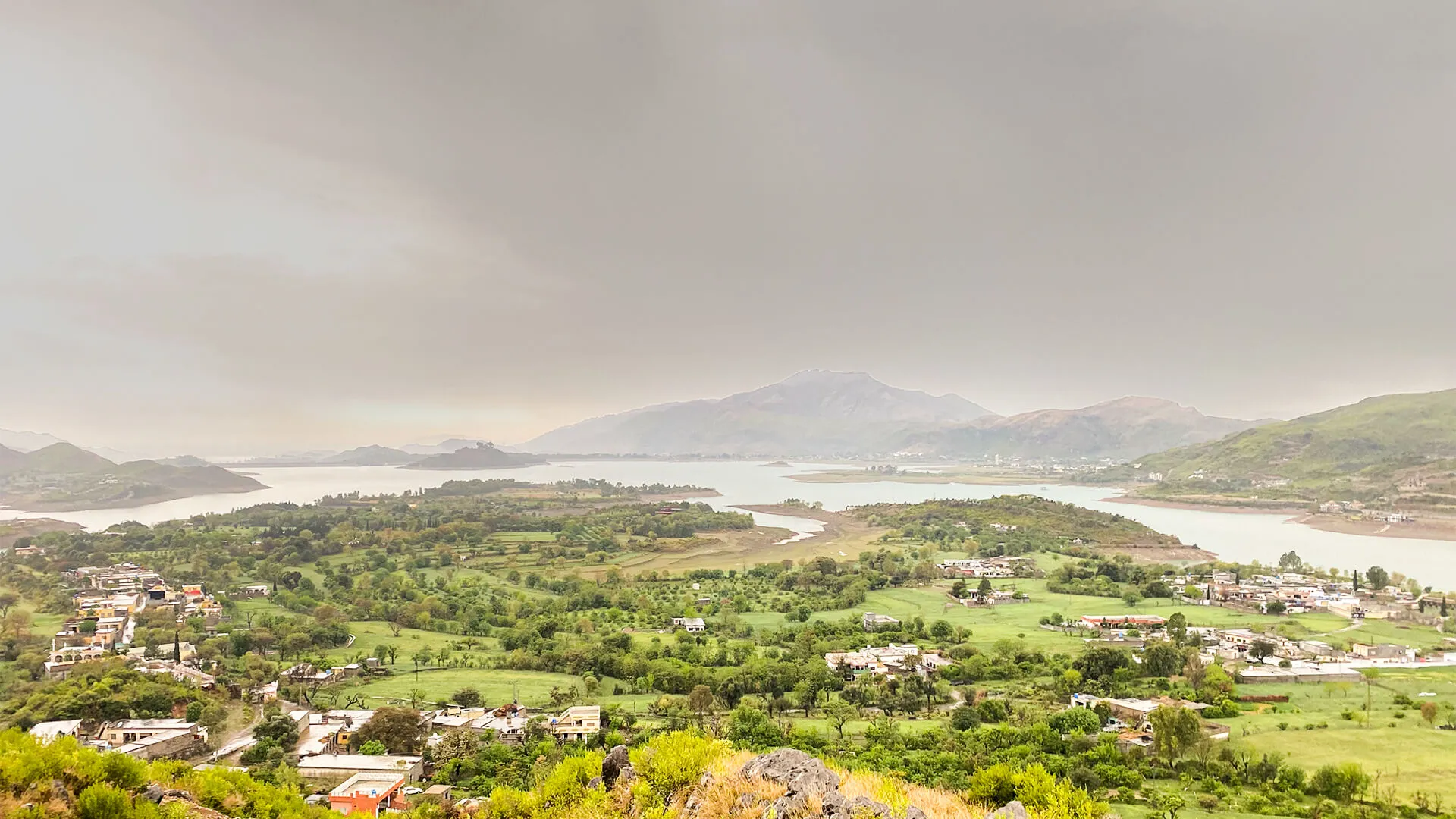
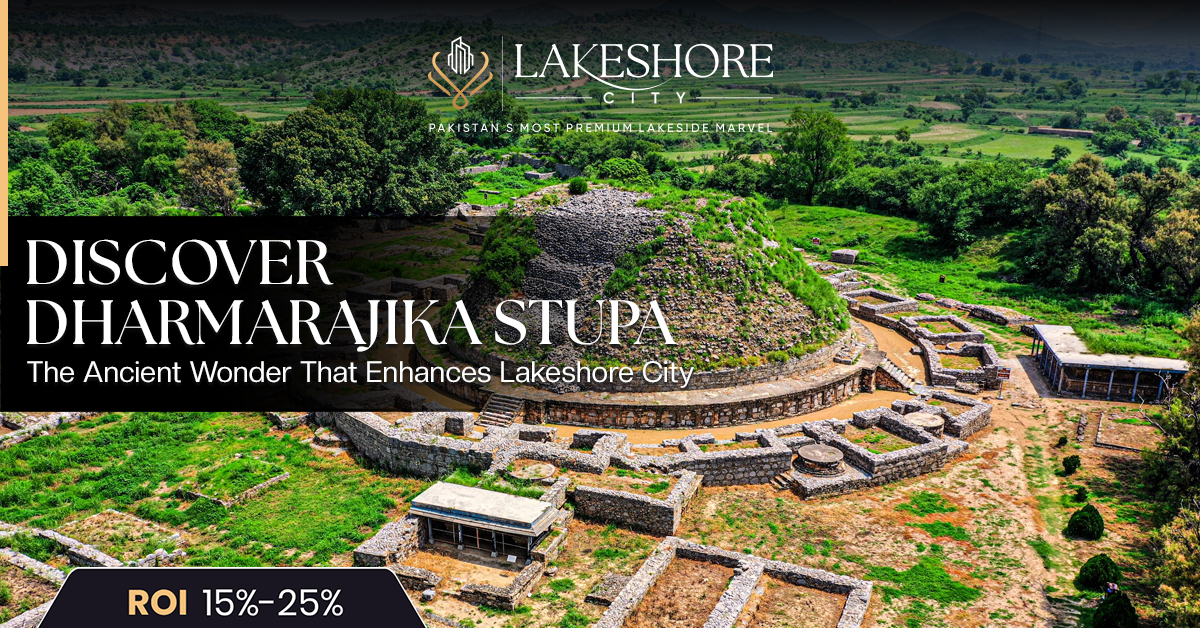
Dharmarajika Stupa is a 3rd-century BCE Buddhist monument near Taxila, built by Emperor Ashoka to enshrine relics of the Buddha. It forms part of the UNESCO-listed Ruins of Taxila and sits within the same Khanpur-Taxila heritage belt as Lakeshore City, a master-planned lakeside community on Khanpur Dam.
Some places ask you to imagine the past. Dharmarajika asks you to stand inside it. Twenty-three centuries ago, an emperor who had renounced war built a stone monument here to hold the relics of the Buddha, and the monks who once walked its circumambulatory path left behind a silence that the site still keeps. A short drive away, on the shores of Khanpur Lake, a very different kind of building is underway: homes, master-planned streets, and a community designed for people who want to live somewhere that means something.
That proximity is not a coincidence of geography so much as a reason to pay attention. Lakeshore City sits within the same Khanpur-Taxila belt that holds some of South Asia’s most significant Buddhist heritage, including Dharmarajika, Jaulian, and Sirkap. For investors and homebuyers evaluating land around Islamabad, this matters in a very practical way: heritage tourism corridors tend to age well. They draw visitors for centuries, not seasons, and the real estate around them benefits from a kind of cultural permanence that newer developments elsewhere cannot manufacture.
This piece looks at what Dharmarajika actually is, why the Gandhara civilization it belonged to still matters to historians and travelers today, and how Lakeshore City’s position within this region shapes both its lifestyle appeal and its long-term investment case.
Dharmarajika Stupa: A Timeless Heritage
Historical Importance
Dharmarajika is the oldest and largest Buddhist religious complex in the Taxila region, built in the 3rd century BCE by the Mauryan emperor Ashoka to enshrine relics of the Buddha. The name itself comes from “Dharmaraja,” a title given to Ashoka for his role in spreading Buddhist teaching after his own conversion from a life of conquest to one of patronage and peace.
The stupa’s story did not end with its construction. An earthquake damaged the original structure in the 1st century CE, and the Kushan dynasty rebuilt it twice over the following centuries, expanding the surrounding monastery and adding dozens of smaller votive stupas. Archaeologists later recovered reliquaries containing gold jewelry, pearls, and lapis lazuli carried along trade routes from as far as Afghanistan, a small but vivid record of how connected this corner of the world once was. The site was eventually abandoned after the White Hun invasions of the 5th century CE, and lay quiet until British archaeologist Sir John Marshall began excavating it in the early twentieth century.
Gandhara Civilization Context
Dharmarajika belonged to a wider world known as Gandhara, a region spanning much of present-day northwestern Pakistan that became one of the ancient world’s great crossroads. Greek, Persian, Central Asian, and South Asian influences met here, producing a distinctive school of Buddhist art and a level of urban sophistication that surprised even the archaeologists who first uncovered it.
The broader story of why this region became so central to Buddhist history is covered in depth in The Gandhara Kingdom: Why Khanpur Lies at the Heart of Buddhist History, which traces how trade, empire, and faith converged in this part of the Indus basin.
Cultural and Tourism Significance
Taxila’s ruins, including Dharmarajika, were inscribed as a UNESCO World Heritage Site in 1980, and the Taxila Museum nearby houses much of what was recovered from the stupa, including Gandharan sculpture spanning the 1st to 7th centuries CE. For travelers, the appeal goes beyond a single monument. Within a compact radius sit Dharmarajika, the Jaulian monastery, the ancient walled city of Sirkap, and Khanpur Lake itself, allowing a single trip to combine archaeology, history, and scenery in a way few destinations in the region can match.
A fuller survey of these nearby monasteries and what each one offers a visitor is available in Taxila’s Treasures: Exploring Ancient Buddhist Monasteries Near Khanpur.
Lakeshore City and the Heritage Connection
Geographic and Lifestyle Synergy
Lakeshore City is positioned on Khanpur Dam, within the same heritage belt that holds Dharmarajika and the wider Taxila archaeological zone. Khanpur Dam itself sits roughly 18 kilometers from the Taxila Museum area, close enough that visitors regularly combine a heritage day trip with an afternoon at the lake. For residents of Lakeshore City, that means waking up inside a region that draws scholars, history students, and international tourists, rather than simply reading about one on a map.
Tourism and Residential Appeal
Few residential developments near Islamabad can claim genuine proximity to a UNESCO World Heritage Site and its surrounding archaeological landscape. That dual identity, lakeside resort and heritage gateway, gives Lakeshore City an appeal that extends past the typical homebuyer to weekend travelers, overseas Pakistanis visiting on cultural trips, and tourism-linked commercial interest.
A broader look at the cultural sites worth visiting from the community is available in Cultural Heritage Attractions Near Lakeshore City You Must Visit, which maps out the full range of historical and natural landmarks within reach.
Value Appreciation Through Cultural Proximity
Heritage tourism corridors tend to support real estate demand differently than purely residential ones. They attract recurring visitor traffic year after year, which supports hospitality, retail, and short-stay rental interest in addition to standard residential demand. Properties positioned within an established heritage and recreation corridor often benefit from this layered demand base, though the extent of any appreciation depends on broader market conditions, infrastructure delivery, and tourism growth, and should not be treated as guaranteed.
The Investment Perspective
ROI Potential Near Heritage Tourism Zones
Globally, real estate near established heritage and natural attractions has tended to hold value well over long horizons, supported by steady tourism rather than purely speculative demand. Pakistan’s own heritage tourism sector remains earlier in its development curve compared to more mature destinations, which can mean more room for early entry but also less price history to rely on. Investors should treat any return projection tied to heritage tourism proximity as a market estimate based on comparable patterns elsewhere, not as a guaranteed outcome for any specific plot or project.
Real Estate Appreciation Logic
The appreciation case for Lakeshore City rests on a combination of factors rather than the heritage angle alone: its position on Khanpur Dam, its access to the Taxila-Haripur road network, growing interest from overseas Pakistanis in lakeside and heritage-adjacent property, and the broader master-planning standards that distinguish it from older, informally developed plot schemes in the area.
Future Development Outlook
As road infrastructure around Khanpur and Taxila continues to improve and as domestic heritage tourism gradually expands, well-positioned communities in this corridor stand to benefit from both rising visitor numbers and rising residential demand. That said, infrastructure and tourism development timelines in this region, as in much of Pakistan, can shift, and prospective buyers should verify current project status and regional development plans directly with developers and local authorities before making investment decisions.
| A Note on Investment Claims Any figures, appreciation ranges, or rental yield estimates referenced in heritage-tourism real estate commentary, including in this article, should be treated as general market observations rather than guarantees. Actual outcomes depend on entry price, holding period, regional infrastructure delivery, and tourism growth, all of which can vary. Readers are encouraged to conduct independent due diligence and consult licensed financial or real estate professionals before making investment decisions. |
Lifestyle Benefits of Living Near Cultural Landmarks
- Modern living near cultural landmarks: residents can access centuries of Gandhara history within a short drive, an amenity no amount of new construction elsewhere can replicate
- Eco-tourism and a peaceful environment: Khanpur Lake’s surroundings offer boating, fishing, and lakeside recreation alongside the quieter pace that comes with being outside a dense urban core
- A high-end community lifestyle: master-planned infrastructure, defined sectors, and flexible payment structures bring a level of order that distinguishes planned communities from informal land schemes
| “Few places let you wake up beside a lake and visit a 2,300-year-old monument before lunch.” |
Why Lakeshore City Stands Out
Competitive Advantage vs Other Societies
Plenty of housing societies near Islamabad promise scenery or convenience. Few can point to a UNESCO World Heritage Site and an active archaeological landscape within their immediate region, alongside lakefront access on Khanpur Dam. That combination of natural and cultural assets is difficult for newer, more generic developments to replicate, regardless of how aggressively they market themselves.
Master Planning and Lifestyle Integration
Lakeshore City’s broader offering, spanning residential sectors, Lakeshore Farms, and commercial zones, is structured around the idea that residents should not have to choose between lifestyle and location. The heritage corridor surrounding Khanpur adds a dimension that few comparable projects can offer: a sense of place rooted in something older than the development itself.
For investors specifically weighing the numbers, Investing in Khanpur: Pakistan’s Top Lakeside Investment Opportunity lays out the broader case for the Khanpur corridor as a long-term holding.
Conclusion: Where History Meets the Future
Dharmarajika has stood through empires, earthquakes, invasions, and centuries of silence, and it is still standing. That kind of permanence is rare, and it is part of what makes the Khanpur-Taxila corridor more than just another scenic location near Islamabad. Lakeshore City sits inside that same story, close enough to let residents step out of the present and into 2,300 years of history in a single afternoon, and back into a master-planned lakeside home by evening.
For investors, the case is not built on heritage tourism alone, but heritage tourism adds a layer of long-term relevance that few developments near Islamabad can claim. As Khanpur’s profile as both a recreational and cultural destination continues to grow, the window to enter at current pricing will not stay open indefinitely.
Frequently Asked Questions
1. What is Dharmarajika Stupa and why is it significant?
Dharmarajika Stupa is a 3rd-century BCE Buddhist monument near Taxila, built by Emperor Ashoka to enshrine relics of the Buddha. It is the oldest and largest Buddhist complex in the Taxila region and forms part of the UNESCO-listed Ruins of Taxila, making it one of the most historically significant Buddhist sites in South Asia.
2. How far is Dharmarajika Stupa from Lakeshore City?
Dharmarajika sits within the Taxila archaeological zone, roughly 18 kilometers from Khanpur Dam, where Lakeshore City is located. The drive is short enough that visitors routinely combine a heritage trip to Taxila with time at Khanpur Lake in the same day.
3. What was the Gandhara civilization?
Gandhara was an ancient region centered on present-day northwestern Pakistan that became a major center of Buddhist learning and art between roughly the 1st and 7th centuries CE, shaped by Greek, Persian, Central Asian, and South Asian influences. Taxila, including Dharmarajika, was one of its most important urban centers.
4. Is real estate near heritage and tourism sites a good investment?
Real estate near established heritage and natural attractions has historically tended to hold value well over long horizons due to recurring tourism demand, though outcomes vary by location and depend on infrastructure, market conditions, and tourism growth. Any specific return projection should be treated as a market estimate, not a guarantee, and verified through independent research.
5. What other heritage sites are near Lakeshore City?
The surrounding Taxila-Khanpur belt includes Dharmarajika Stupa, the Jaulian monastery, the ancient city of Sirkap, and the Taxila Museum, along with Khanpur Lake’s own recreational attractions, giving residents and visitors a wide range of cultural and natural sites within a short drive.
6. What makes Lakeshore City different from other housing societies near Islamabad?
Lakeshore City combines lakefront positioning on Khanpur Dam with proximity to a UNESCO World Heritage archaeological landscape, a pairing of natural and cultural assets that few comparable developments in the region can offer, alongside its master-planned residential, farm, and commercial sectors.