Where the Silk Road Once Slowed Down
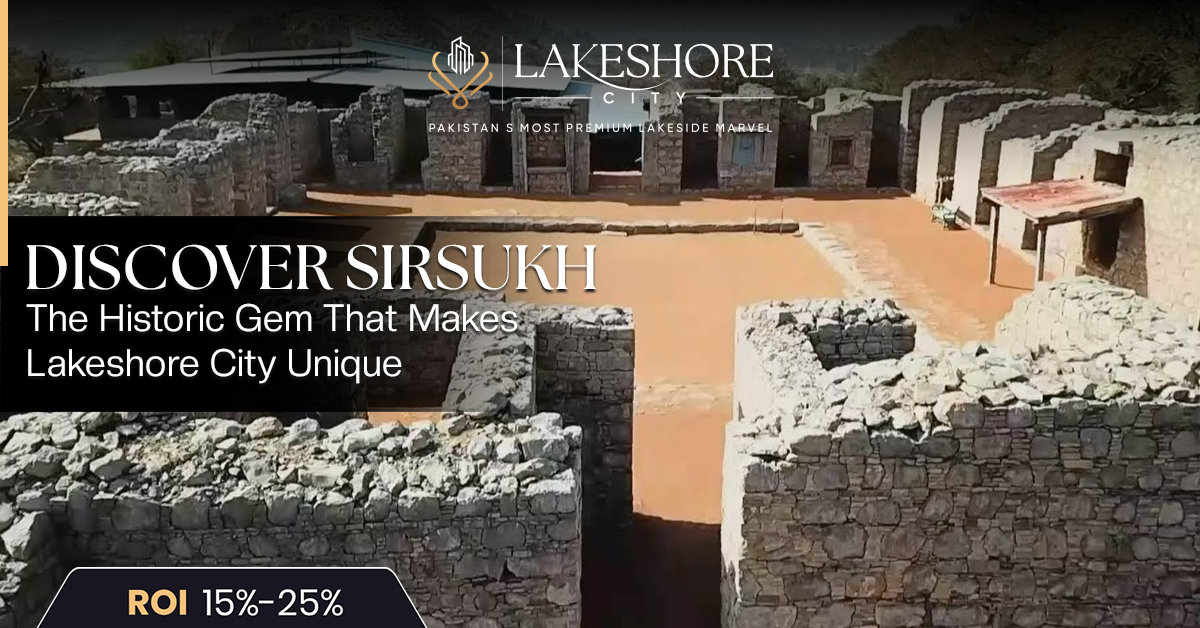
Long before highways connected Islamabad to the north, before Khanpur Dam became a weekend escape, and long before anyone drew a master plan for a gated community, a different kind of city stood on this same stretch of land. It had walls thick enough to stop an army, round bastions built in a style borrowed from beyond Persia, and a name that has survived nearly two thousand years: Sirsukh.
Today, Sirsukh is a quiet field of stone foundations a short drive from Taxila. Most travelers heading toward Khanpur or Haripur pass within a few kilometers of it without realizing they have just crossed one of the last great cities of the Kushan Empire. But for anyone evaluating real estate near Taxila, that proximity is not trivia. It is context. It tells you something about why this corridor has mattered for two millennia, and why it is starting to matter again.
This is the story of Sirsukh: what it was, why archaeologists and historians still study it, and why a heritage-anchored location like this changes the investment calculus for a modern development like Lakeshore City.
What Is Sirsukh? A Featured-Snippet Definition
| Quick Answer: Sirsukh is the ruined city of the ancient Kushan Empire, founded in the late 1st century CE near Taxila in present-day Punjab, Pakistan. It was the third and final major city built on the Taxila site, following Bhir Mound and Sirkap, and is recognized today as part of the Taxila UNESCO World Heritage Site, designated in 1980 under criteria iii and iv. |
Sirsukh sits roughly 33.77°N, 72.85°E, on a plain just north of Taxila’s older settlements. It was built after the Kushans, a nomadic power originating in Central Asia, took control of the region around 80 CE. Rather than rebuild on the earthquake-damaged ruins of Sirkap, the Kushan rulers chose open ground and laid out an entirely new fortified city.
What makes Sirsukh stand apart from the older cities at Taxila is its engineering. The perimeter wall stretches roughly five kilometers and is several meters thick, built from large stone blocks packed with smaller stones in between, smooth on the outer face. Round bastions, spaced at regular intervals along the wall, contained loopholes for archers — a defensive design that historians consider one of the earliest known examples of circular fortification architecture outside Europe, likely absorbed through Kushan contact with western trade routes.
Unlike the more thoroughly excavated Sirkap, much of Sirsukh remains unexcavated. Local agricultural land covers large sections of the site, and significant disruption would be needed to dig further. What has been studied: a narrow excavated strip along the Lundi rivulet that runs beside the walls, which has already yielded coin hoards spanning multiple ruling periods, giving archaeologists a working timeline even without a full excavation.
Why Sirsukh Matters in Taxila’s Civilization Story
Taxila did not become a UNESCO World Heritage Site because of any single ruin. It earned that designation because the site preserves four distinct, layered settlements that together chart the entire evolution of an ancient Indus city — from the Neolithic-era Saraikala mound, through the Greek-influenced ramparts of Sirkap, to the Kushan-era city of Sirsukh. Sirsukh is the final chapter in that sequence, and it tells a story none of the earlier cities can.
The Last of Taxila’s Great Cities
Historians attribute Sirsukh’s founding to the great Kushan ruler Kanishka, whose empire at its height stretched from Central Asia to the edges of the Aral and Arabian Seas. Building an entirely new capital city was not a small undertaking. It signaled permanence, ambition, and a deliberate statement of Kushan power following their conquest of the Gandhara region.
Sirsukh’s layout reflects Central Asian urban planning, a sharp departure from the Greek-style grid of Sirkap before it. Historians read this as physical evidence of how thoroughly the Kushans reshaped Taxila’s identity, replacing a Hellenistic-influenced city with one built in their own architectural language, complete with suburbs extending beyond the main walls.
A Crossroads City, Not a Frontier Town
Taxila’s importance, across every era including Sirsukh’s, came from geography. The city sat at the meeting point of three major trade routes: one running east toward the Gangetic plains, one west toward Persia and the Mediterranean, and one north toward Kashmir and Central Asia. This was the Silk Road’s southern artery, and Sirsukh inherited that position at the height of Kushan-era trade, when caravans, monks, and merchants moved goods and ideas between China, India, and the Roman world.
Buddhist pilgrims traveled from as far as China and Central Asia to visit the monasteries that ringed Sirsukh, including the hillside complex at Jaulian. The Greek philosopher Apollonius of Tyana is recorded as having visited Taxila during this period, describing a city fortified “like the Greek cities” and comparable in scale to Nineveh — a striking outside account of just how significant this place was on the ancient world stage.
| Sirsukh was not a ruin waiting to happen. It was a deliberate statement — a new capital built to declare that an empire had arrived, and that this stretch of land mattered enough to defend with five kilometers of stone wall.— On the strategic significance of Kushan-era Taxila |
Why This Matters for Gandhara Civilization Research
Sirsukh’s coin hoards, spanning Kushan rulers and later periods, give historians a continuous monetary record that helps date events across the wider Gandhara civilization. For a region whose Buddhist art and architecture influenced cultures from Afghanistan to Central Asia, Sirsukh functions as a chronological anchor point — evidence of exactly when Kushan power peaked in this corridor, and how long it endured before later invasions, including incursions by the Sasanians and eventually the Huns, brought the city’s prosperity to an end by the mid-5th century CE.
The Connection Between Sirsukh and Lakeshore City
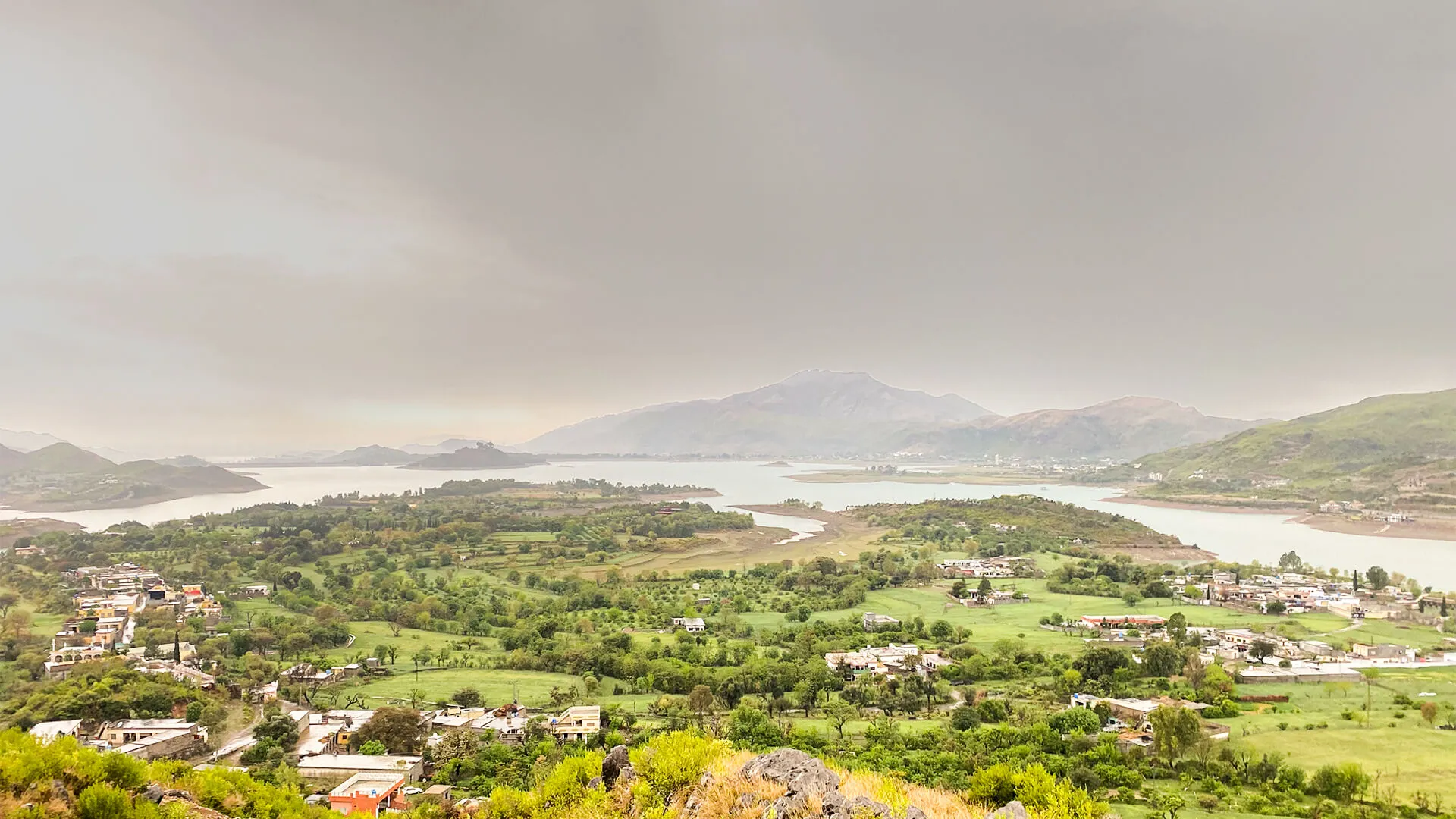
Lakeshore City is not built on the Sirsukh ruins, and no responsible real estate brand should ever suggest otherwise about a protected UNESCO site. The relationship is geographic and cultural, not literal. Lakeshore City sits within the same historic corridor — the Islamabad–Khanpur Dam belt that has connected this region to trade, settlement, and civilization for over two thousand years.
That distinction matters more than it might first appear. As explored in the rich history of Taxila and its impact on Lakeshore City, this entire belt of land has functioned as a corridor of movement and exchange since before recorded Pakistani history. Sirsukh’s builders chose this ground for the same underlying reasons that make it valuable today: accessibility, defensible terrain, and a position along the natural routes connecting the north of the subcontinent to everywhere else.
When a development sits inside a region with this level of documented civilizational continuity, it inherits something a brand-new master-planned city in an unremarkable location simply cannot manufacture: narrative depth. Buyers are not just purchasing a plot near Taxila. They are purchasing a stake in a corridor that has mattered to every empire that has touched this part of South Asia, from the Achaemenids and Greeks to the Kushans and Mughals.
For a closer look at how this layered history directly shapes Lakeshore City’s site selection and master plan, see the rich history of Taxila and its impact on Lakeshore City.
The Investment Value of Heritage-Linked Locations
Real estate near recognized heritage zones behaves differently than real estate in generic suburban corridors, and the reasons are well documented across global property markets, not just in Pakistan.
Why Heritage Proximity Drives Long-Term Demand
- Permanent tourism demand: UNESCO World Heritage Sites generate consistent domestic and international visitor traffic for decades, sustaining demand for nearby hospitality, retail, and residential infrastructure long after initial development hype fades.
- Protected scarcity: heritage zones cannot be over-developed the way ordinary land can. Archaeological protection limits competing high-density construction directly on top of these sites, which preserves the surrounding area’s character and exclusivity.
- Government infrastructure priority: roads, utilities, and connectivity projects serving heritage corridors tend to receive sustained public investment because tourism and cultural preservation carry political and economic weight.
- Narrative-driven marketing value: a development near a UNESCO site has a built-in story that resonates with both local buyers and overseas Pakistanis looking to invest in land tied to identity and heritage, not just square footage.
Taxila’s Heritage Status as a Market Signal
Taxila’s UNESCO designation, combined with its ongoing archaeological relevance, functions as a long-horizon market signal for investors. As detailed in unveiling the ancient treasures of Taxila and Gandhara, the broader Gandhara heritage trail across this region continues to draw scholarly attention, conservation funding, and cultural tourism initiatives — all of which compound the desirability of well-positioned land nearby.
This is the same dynamic seen around heritage zones worldwide: Florence, Luang Prabang, and the Nile Valley around Luxor all show measurable real estate premiums in well-located areas adjacent to protected sites, sustained by tourism infrastructure, government conservation spending, and a steady flow of visitors who never stop coming.
Why Lakeshore City Is Strategically Positioned Near the Taxila Heritage Belt
Location decisions in real estate are rarely accidental, and Lakeshore City’s position along the Islamabad–Khanpur Dam corridor reflects a calculated read of where this region is heading, not just where it has been.
Connectivity Without Crowding
Lakeshore City benefits from proximity to the Taxila heritage belt while avoiding the density and congestion that comes with sitting directly inside a historic urban core. Buyers get the narrative and tourism upside of the region without the planning restrictions or traffic pressure that come with developing land immediately adjacent to protected archaeological zones.
A Growth Corridor With Built-In Demand Drivers
- Year-round domestic tourism to Khanpur Dam, layered with Taxila’s heritage and archaeological tourism, creates a dual demand base rather than a single seasonal driver.
- Improving regional connectivity continues to shorten travel time between Islamabad, Taxila, and the wider Khanpur corridor, widening the practical commuter and weekend-home radius.
- Government and private investment in northern Punjab’s tourism and infrastructure has accelerated interest in land along this belt over the past several years.
These factors are exactly why Lakeshore City has been positioned as the top real estate investment in Taxila — not because of proximity to any single site, but because of where it sits within an entire regional growth pattern that heritage tourism, lakefront recreation, and improving infrastructure are reinforcing simultaneously.
Modern Living Meets Ancient Civilization
There is a particular kind of value in living somewhere with depth. A new housing scheme built on featureless farmland offers convenience and little else. A community built within a corridor that has hosted Achaemenid administrators, Greek generals, Mauryan emperors, and Kushan kings offers something a marketing department cannot fabricate: a sense of place.
Lakeshore City’s positioning leans into this directly. Its lakefront access near Khanpur Dam delivers the modern lifestyle amenities today’s buyers expect — recreational waterfront space, planned infrastructure, and a master-planned community — while its location within the Taxila corridor connects residents to one of the most studied ancient civilizations in South Asia. Weekend visits to the Taxila Museum, the Dharmarajika Stupa, or the Sirkap excavations become a short drive rather than a planned expedition.
This is the modern living meets ancient civilization concept in practice: a home that functions for contemporary life while sitting inside a landscape that has been continuously significant for over two thousand years. Few developments anywhere in Pakistan can credibly make that claim.
| A Limited Window Along a Two-Thousand-Year Corridor Land along heritage-adjacent growth corridors does not stay available indefinitely. As infrastructure and tourism investment in the Khanpur–Taxila belt continue to accelerate, early-phase pricing at Lakeshore City reflects today’s market, not tomorrow’s.Plots are moving as awareness of this corridor’s heritage and investment value spreads among both local and overseas Pakistani buyers.Speak with the Lakeshore City investment team today to review available plots and current pricing before the next phase release. |
Frequently Asked Questions About Sirsukh and Lakeshore City
What is Sirsukh known for?
Sirsukh is known as the third and final great city built at Taxila, founded by the Kushan Empire in the late 1st century CE. It is recognized for its five-kilometer fortified wall with round defensive bastions, a design influence rarely seen elsewhere in the ancient world at that time, and for its role as the last major urban center before Taxila’s eventual decline.
Is Sirsukh part of a UNESCO World Heritage Site?
Yes. Sirsukh is one of four key archaeological components of the Taxila UNESCO World Heritage Site, designated in 1980. The other major components include Bhir Mound, Sirkap, and the Saraikala mound, along with numerous Buddhist monastery and stupa remains across the Taxila valley.
How far is Sirsukh from Lakeshore City?
Sirsukh sits within the broader Taxila heritage belt along the Islamabad–Khanpur Dam corridor where Lakeshore City is located. Exact drive times vary by route and current road conditions; buyers are encouraged to confirm precise distances directly with the Lakeshore City sales team for the most current access information.
Why is real estate near Taxila considered a good investment?
Real estate near Taxila benefits from a combination of sustained heritage tourism, UNESCO-driven conservation attention, improving regional infrastructure, and the natural scarcity that comes with protected archaeological zones limiting unchecked development nearby. These factors have historically supported long-term land value growth in comparable heritage-adjacent corridors worldwide.
What is the Gandhara civilization, and how does it relate to Taxila?
Gandhara was an ancient civilization centered in present-day northern Pakistan and eastern Afghanistan, renowned for its distinctive fusion of Greek and Buddhist artistic traditions. Taxila served as one of Gandhara’s most important urban and intellectual centers, and Sirsukh represents Gandhara’s late Kushan-era phase, when the region’s Buddhist art and architecture reached their most refined expression.
Can visitors tour the Sirsukh ruins today?
Sirsukh remains partially unexcavated, with much of the site covered by surrounding agricultural land. Visitors typically view the more accessible excavated areas of Taxila, including Sirkap and the Dharmarajika Stupa, alongside the Taxila Museum, which displays artifacts recovered from across the Taxila valley, including Sirsukh.
A Legacy Worth Building Beside
Empires rise and fall. Trade routes shift. Cities get abandoned and reclaimed by farmland for a thousand years. But some locations keep mattering, generation after generation, because the underlying reasons they were chosen in the first place never really go away. Sirsukh’s builders understood the value of this ground in 80 CE. The Buddhist pilgrims who walked here from China understood it. The archaeologists who still study its walls understand it now.
Lakeshore City is the next chapter of a corridor that has never stopped being relevant. Investing here is not just about acquiring land near a lake and a dam. It is about placing a stake in a stretch of Pakistan that has anchored trade, culture, and settlement for two thousand years, and is only now being rediscovered by a new generation of investors and homeowners.
The history is permanent. The opportunity to buy into it at today’s prices is not.
| Build Your Future Beside Pakistan’s Ancient Heartland Lakeshore City offers plot options designed for families, investors, and overseas Pakistanis seeking a meaningful, heritage-linked stake in one of the region’s fastest-developing corridors. Inventory in current phases is moving steadily as more buyers recognize the long-term value of this location. Contact the Lakeshore City team today to schedule a site visit and secure your plot before prices move with the next phase. |