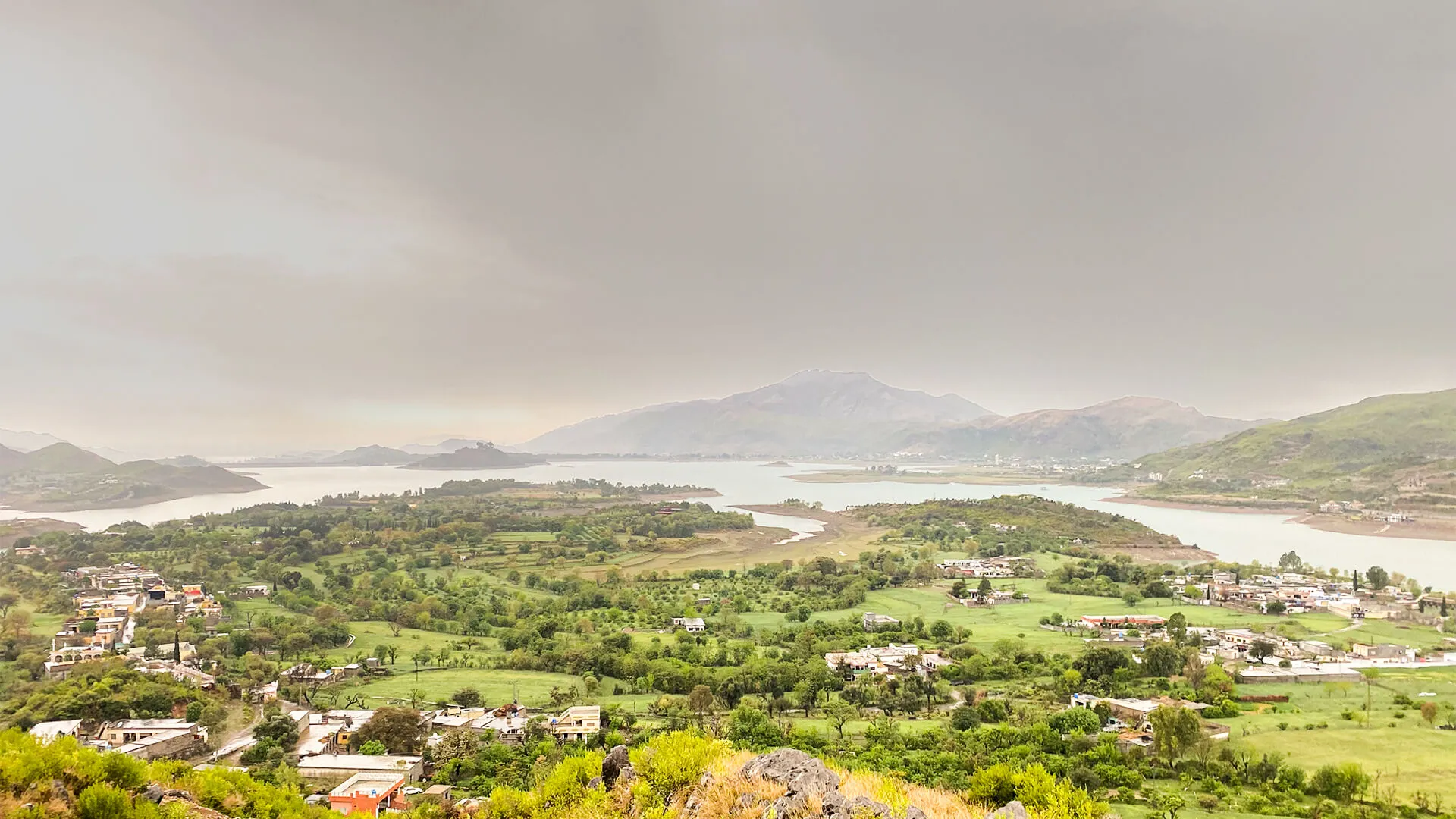
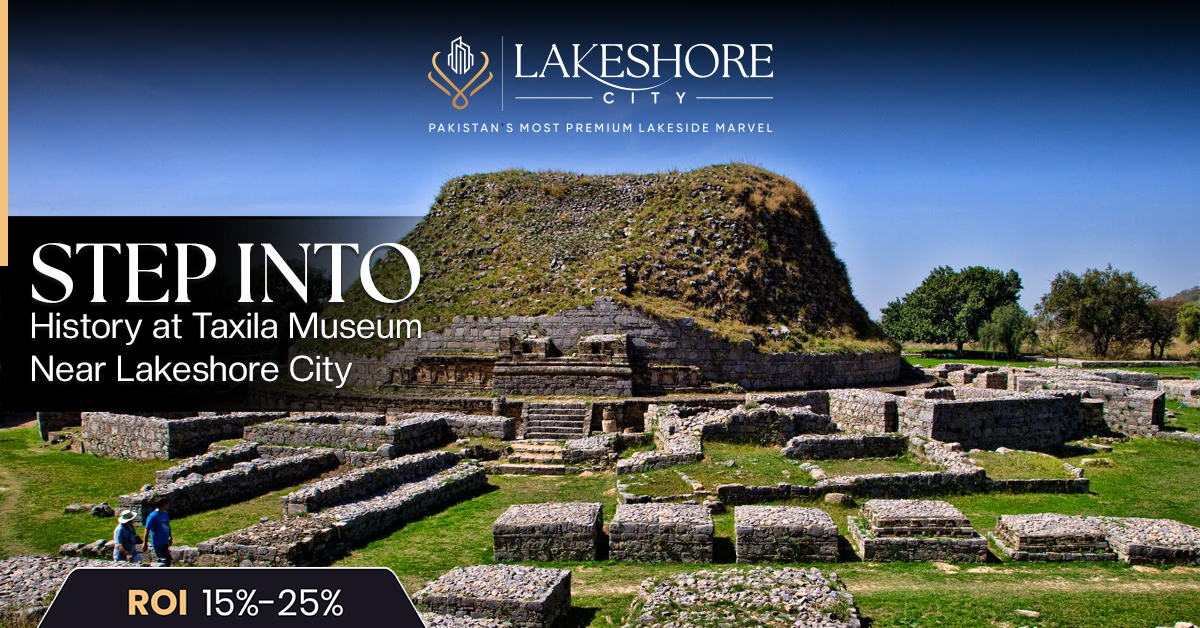
About an hour and a half north of Lakeshore City, past Khanpur Dam and through the gradual shift from rolling hills to the Potohar Plateau, sits one of South Asia’s most important archaeological sites. The Taxila Museum holds roughly 4,000 years of human history within a single building — Buddhist sculptures pulled from the earth, coins minted before the birth of Christ, jewelry worn by people who never imagined a world like ours.
Most visitors from the Khanpur and Attock region spend their weekends at the dam or along the Lakeshore waterfront. That makes sense. The water is close, the setup is easy, and the views pay off. But for anyone who has lingered by the lake and thought, “What else is out here?” — Taxila is the answer worth driving for.
Why Taxila Museum Belongs on Your List
Taxila is not a typical museum trip. It is not a collection of dusty labels and unfamiliar names. The objects here have weight — not just physical weight, but the kind that makes you stop in front of a carved stone head and realize it was sculpted sometime around the 2nd century CE by a craftsman whose name no one recorded.
The museum sits within a UNESCO World Heritage Site. The broader Taxila valley contains ruins from at least three separate ancient cities — Bhir Mound, Sirkap, and Sirsukh — and several important Buddhist monasteries including Dharmarajika and Jaulian. What the museum does is pull the best-preserved finds from those excavations into one place, organized and explained.
For families, it works well because the exhibits are varied enough to hold attention across ages. Coins and jewelry appeal to younger visitors in a way that architectural ruins sometimes don’t. For history enthusiasts, the Gandhara Buddhist sculpture collection is one of the finest in Pakistan. For anyone interested in ancient trade routes, the artifacts here connect the subcontinent to Greece, Persia, and Central Asia in ways that feel almost implausible until you’re standing in front of the evidence.
The Historical Weight of Taxila
Taxila was a major city in the ancient world for roughly a thousand years. It sat on the trade route connecting the Persian Empire to the Indian subcontinent — the road that later became part of what historians loosely call the Silk Road. Alexander the Great passed through in 326 BCE. The Mauryan Empire controlled it under Chandragupta. Ashoka, who converted to Buddhism after the carnage at Kalinga, built some of the earliest Buddhist structures here.
The Gandhara civilization that developed here produced a style of Buddhist art that mixed Greek sculpture with Indian Buddhist iconography. The result is unlike anything else from the ancient world: Buddha figures with Mediterranean-style robes, stone friezes that could pass for Greek relief work except for the subject matter. Scholars have been arguing about the extent of Greek influence for over a century, and the Taxila Museum’s collection puts the debate into physical form.
Sir John Marshall, the British archaeologist who directed excavations here from 1913 to 1934, described Taxila as one of the richest archaeological sites in the world. His work, and the work of Pakistani archaeologists who followed, produced the collection now on display.
The museum building itself was constructed in 1928 and renovated several times since. It is not a state-of-the-art facility by international standards, but the collection is genuine and substantial. The labeling could be more detailed in places, which is an honest limitation worth knowing before you arrive.
Travel Distance and Getting There from Lakeshore City
Lakeshore City is located near Khanpur Dam in Attock District. From there, Taxila is approximately 90 to 110 kilometers depending on your exact route, which puts the drive at roughly 1.5 to 2 hours under normal traffic conditions.
The most practical route runs through Attock and along the Grand Trunk Road toward Rawalpindi, then north toward Taxila. The road quality on this stretch is generally reliable. Taxila town itself is easy to navigate — the museum and major ruins sites are well-signposted.
GPS coordinates for Taxila Museum: 33.7456° N, 72.8428° E
If you are coming from Rawalpindi or Islamabad to visit Lakeshore City, Taxila makes a natural stop in either direction. It sits close enough to the motorway that adding it to a weekend trip from the capital adds only a modest detour.
There is no direct public transport from Khanpur to Taxila. Most visitors arriving from Lakeshore City will come by private car or hired vehicle. The parking at Taxila Museum is adequate and free.
What You Will Find Inside the Museum
The museum is organized into several galleries arranged more or less chronologically, though the progression is not always strict. Here is what occupies most visitors’ time:
The Gandhara Sculpture Collection
This is the main draw. Carved mostly from grey schist stone, the Buddhist sculptures here range from small votive figures to large narrative relief panels depicting scenes from the life of the Buddha. The craftsmanship is detailed — folds in robes, expressions on faces, compositional groupings that tell stories across a single panel. The Hellenistic influence is visible in the treatment of drapery and portraiture. It does not look like what most people expect Indian Buddhist art to look like, and that dissonance is interesting.
Coins and Currency
One of the more unexpectedly compelling sections. The coin collection spans several empires and centuries — Indo-Greek coins with bilingual inscriptions, Kushan coins with royal portraits, Parthian and Sassanid influences all sitting next to each other. For anyone interested in how trade and political power intersected in the ancient world, this section rewards slow looking.
Jewelry and Everyday Objects
Rings, bangles, beads, terracotta figurines, household vessels. These objects close the distance between the ancient city and the present in a way that sculpture doesn’t always manage. A clay toy from 2,000 years ago is recognizable. It was made for a child.
Architectural Fragments
Stupa decorations, carved friezes, column capitals. These give a sense of what the buildings they came from once looked like. Combined with a visit to Dharmarajika or Jaulian after the museum, they help you read the ruins in a way that is not otherwise obvious.
Plan for two to three hours inside the museum to move at a comfortable pace. The grounds outside also contain a few display areas worth walking through.
The Best Time to Visit
October through March is the comfortable window. Taxila sits at roughly 550 meters elevation on the Potohar Plateau, and the winters here are cool but not harsh. December and January mornings can be cold — bring a layer if you plan to walk the outdoor ruins sites after the museum.
April and May are warm and increasingly dusty. June through September is hot and humid, with monsoon rains from July onward that can make outdoor ruins slippery and unpleasant.
The museum opens at 9 AM and closes at 5 PM, six days a week. It is closed on Fridays. Admission for Pakistani nationals is nominal — typically in the range of Rs. 50 to 100 per adult, with lower rates for children. These prices are set by the Department of Archaeology and Museums and can change, so confirm at the entrance.
Weekday mornings are quieter. If you arrive with children and want space to move around without crowds, a Tuesday or Wednesday visit between October and December is ideal.
Nearby Attractions Worth Adding
The Taxila valley has more than any single-day trip can cover fully, but here are the sites that pair best with a museum visit:
Dharmarajika Stupa
A large Mauryan-era Buddhist stupa surrounded by monastery ruins. Dates to the era of Ashoka — likely 3rd century BCE in its original form, though expanded repeatedly. The scale of the complex is easier to grasp in person than in photographs.
Jaulian Monastery
On a hill east of the main Taxila valley, Jaulian has some of the best-preserved courtyard sculptures of any site in the region. The main stupa and surrounding votive stupas still have decorated plaster on the bases in places. Worth the climb.
Sirkap City Ruins
The remains of a Hellenistic-era planned city, laid out on a grid. The Apsis Temple here shows Greek, Parthian, and Indian architectural elements in a single building. The ruins are spread over a large area and require some walking.
Wah Gardens
About 15 kilometers from Taxila, Wah Gardens is a Mughal-era garden complex originally built during Akbar’s reign. Less visited than the Buddhist sites, which means it is often quieter.
Combined with Lakeshore City’s waterfront and the Khanpur Dam area, you can build a two-day heritage and nature itinerary in this region that covers genuine historical depth.
Practical Tips Before You Go
- Bring water and snacks. The museum does not have a cafeteria, and the tea stalls outside are limited.
- Wear comfortable, closed shoes if you plan to visit outdoor ruins sites after the museum. Ground is uneven.
- Photography is permitted inside the museum for personal use. No flash on the sculptures.
- Hire a guide at the museum entrance if you want detailed context — guides who know the collection are available and the fee is reasonable.
- The museum itself is not fully air-conditioned. In summer, the heat inside can be significant by midday.
- Friday is the weekly closure day. Do not plan a visit on Friday.
- If you are driving from Lakeshore City, the full day trip works best if you leave by 7 AM to arrive when the museum opens.
- The nearest fuel stations and sit-down restaurants are in Taxila town, a few minutes from the museum.
A Last Word
The Taxila Museum sits at a crossroads — literally and historically. The city it represents was where the ancient world’s trade routes met, where Greek merchants, Indian scholars, Parthian traders, and Central Asian nomads all passed through and left traces. What the museum holds is the physical record of that intersection.
From Lakeshore City, it is close enough for a day trip but far enough that it requires intention. That is actually the right distance for this kind of place. You have to mean to go. And if you go, you will find something that the waterfront at Khanpur, for all its appeal, cannot offer: the particular quietness that comes from standing in front of an object made two thousand years ago by hands that were, in all the ways that matter, very much like yours.
Taxila is one of the most important archaeological sites in Asia. It happens to be about 90 kilometers from Lakeshore City. That is worth a Saturday.
Frequently Asked Questions
How far is the Taxila Museum from Lakeshore City near Khanpur Dam?
Taxila Museum is approximately 90 to 110 kilometers from Lakeshore City, depending on the route. The drive typically takes 1.5 to 2 hours via the Attock and Grand Trunk Road corridor.
What are the opening hours and entry fees for the Taxila Museum?
The museum opens at 9 AM and closes at 5 PM, Saturday through Thursday. It is closed on Fridays. Entry fees for Pakistani nationals are nominal, generally around Rs. 50 to 100 per adult, with reduced rates for children. Confirm at the gate as prices are periodically updated by the Department of Archaeology and Museums.
Is the Taxila Museum suitable for children and family visits?
Yes. The variety of exhibits — coins, jewelry, terracotta figurines, sculptures — holds the attention of visitors across age groups. Older children who have some context for the history of the region find the Gandhara sculpture collection particularly interesting. The grounds have open walking space as well.
What is the Gandhara civilization and why is Taxila significant to it?
Gandhara was an ancient region roughly corresponding to modern northwestern Pakistan and eastern Afghanistan. It became a center of Buddhist culture from roughly the 3rd century BCE through the 5th century CE. Taxila was one of its major cities and a hub of trade, scholarship, and artistic production. The Gandhara school of Buddhist art, which blends Greek sculptural techniques with Indian Buddhist iconography, is one of the most distinctive artistic traditions of the ancient world, and the Taxila Museum holds one of the finest collections of it anywhere.
What other historical places are near Taxila worth visiting?
The Taxila valley has several major sites close to the museum: Dharmarajika Stupa (Mauryan period), Jaulian Monastery (Kushan period, with well-preserved courtyard sculptures), and Sirkap (Hellenistic-era planned city). Wah Gardens, a Mughal-era heritage site, is about 15 kilometers away. All of these can be visited as part of a full-day heritage itinerary.
What is the best season to visit Taxila from the Khanpur and Attock region?
October through March is the most comfortable period. Temperatures are mild, the air is clearer than in summer, and the outdoor ruins are easy to explore. Avoid June through August if possible — it is hot, and monsoon rains make the outdoor sites muddy and slippery.
Can I visit the Taxila Museum and Lakeshore City on the same trip?
Yes, though they work better as separate days rather than a single day trip. Taxila and its surrounding ruins require at least a full day to explore properly. Lakeshore City and the Khanpur Dam area are a different kind of experience. A two-day itinerary that combines both gives you heritage travel and natural scenery without rushing either.