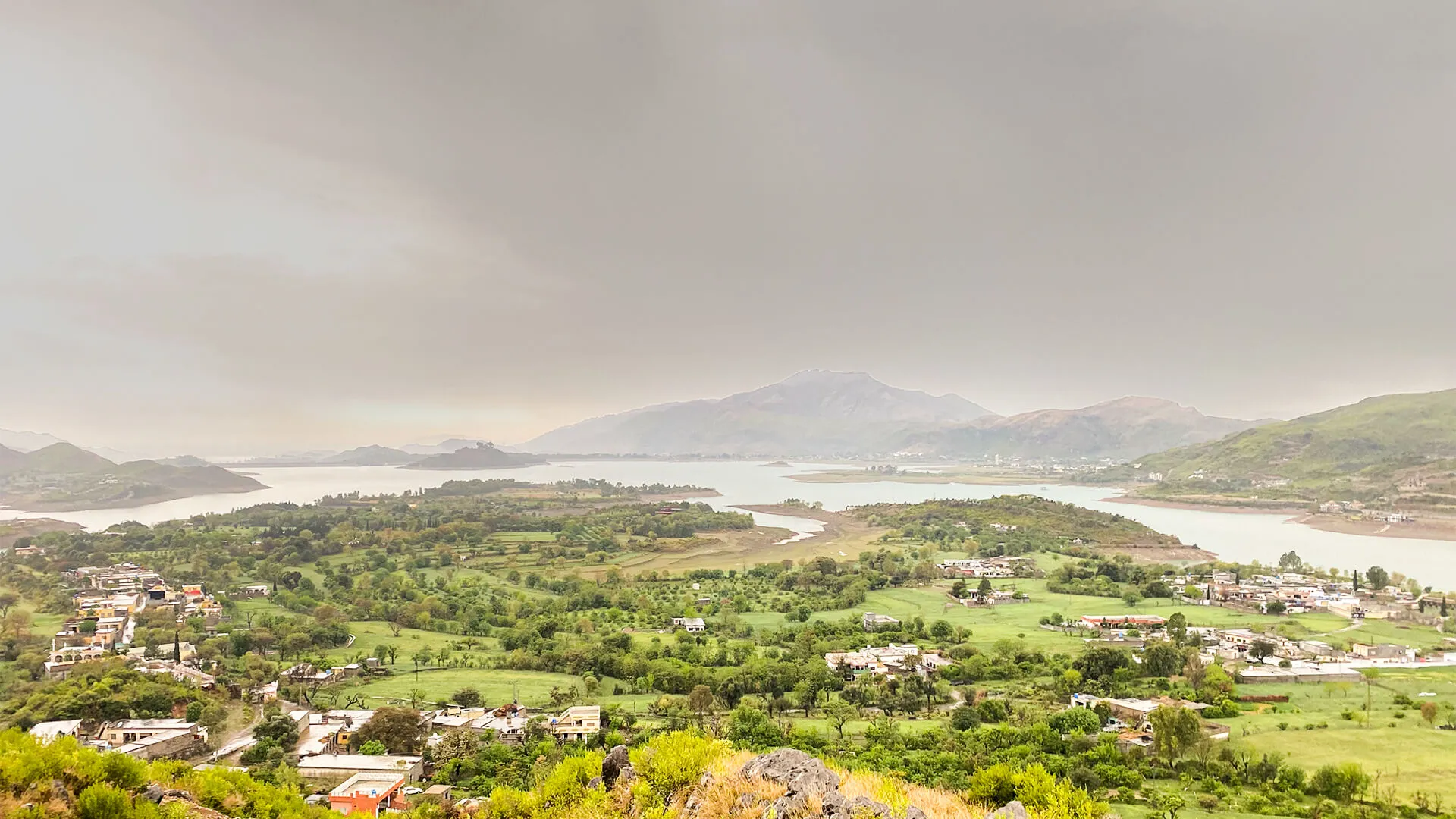
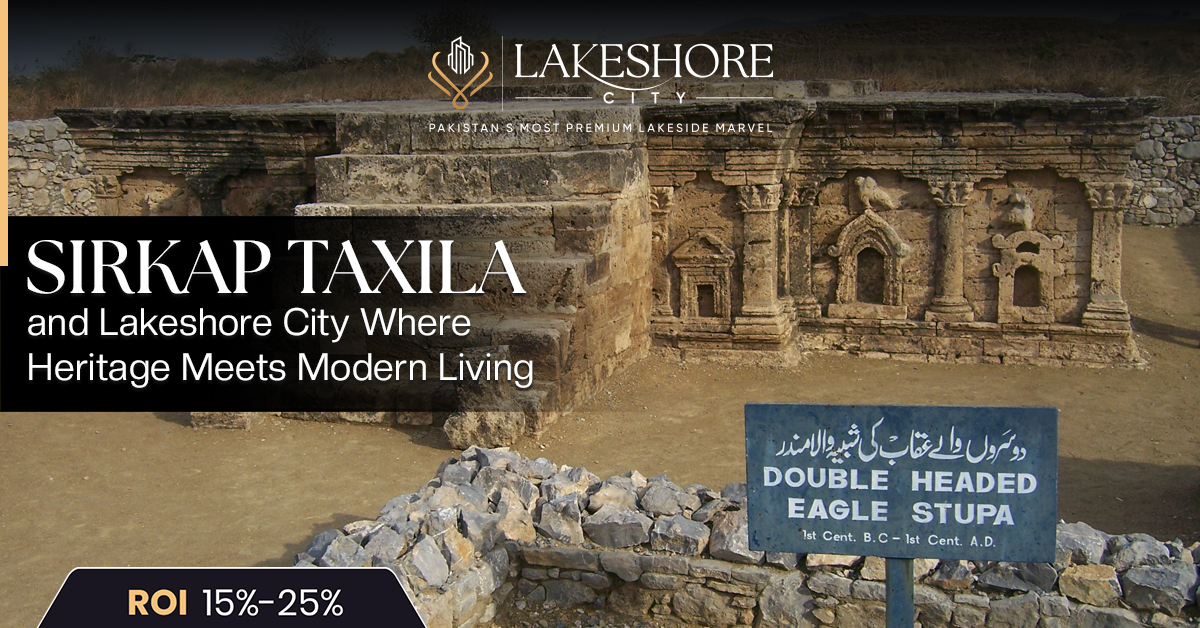
Lakeshore City is a waterfront housing project on the Islamabad-Khanpur Dam corridor, close to the UNESCO-listed Taxila heritage zone that includes the ancient city of Sirkap. Buyers get a planned residential community minutes from one of the region’s oldest archaeological landscapes, with land values tied partly to the area’s growing heritage tourism.
Most housing schemes near Islamabad sell a view, a gate, and a promise of appreciation. Lakeshore City sells all three, but it also sits next to something almost nothing else in the twin cities can offer: a city that is roughly 2,200 years old and still walkable today.
Sirkap, the ancient Indo-Greek settlement across the river from modern Taxila, was laid out as a grid of streets and city blocks centuries before Islamabad existed even as an idea. It sits inside the Taxila UNESCO World Heritage Site, a short drive from Lakeshore City’s gates.
That proximity matters for two different kinds of buyers. One wants a home near a lake with reasonable access to Islamabad and Rawalpindi. The other is watching Pakistan’s heritage tourism numbers grow and wants property in a corridor that benefits from both residential and tourist footfall. Lakeshore City sits exactly where these two interests overlap.
What Is Lakeshore City?
Lakeshore City is a waterfront residential project positioned along the Islamabad-Khanpur Dam corridor, built around the dam’s lake views and the hills around it. It is marketed as a planned community: defined plot categories, an internal road network, and the kind of utility planning buyers in this price bracket have come to expect after years of disputed or half-finished housing schemes in the region.
The pitch is simple. Rising land prices inside Islamabad’s sectors have pushed buyers further out along feeder roads and dam corridors in search of plots that still cost less than anything inside the capital. Khanpur Dam, Taxila, and the hills around them give this particular corridor something most of those feeder-road schemes do not have: scenery and a documented historical identity, not just proximity to a highway.
Lakeshore City connects to the wider area through Alexander Road, and the Khanpur Dam tunnel project, once finished, is expected to shorten travel time between this corridor and the rest of Islamabad-Rawalpindi. For a buyer comparing plots, that combination of dam-side living, nearby heritage tourism, and improving road infrastructure is the real argument, more than any single amenity on a brochure.
The Historical Weight of Sirkap and Taxila
Most real estate copy treats nearby history as a footnote. It deserves more than that here, because it is the reason Taxila draws visitors year-round, and the reason a project built around heritage tourism has something real to point to rather than a marketing line.
Sirkap was built around 180 BCE by the Greco-Bactrian king Demetrius I, after Indo-Greek forces took control of the region following Alexander the Great’s campaign there decades earlier. The city he laid out was not an organic settlement that grew over time. It followed a Hippodamian grid plan, the same style of deliberate street-and-block layout used in classical Greek cities, built around a main avenue cut by roughly fifteen cross streets. Houses, shops, temples, and stupas sat in regular blocks along that grid, an unusually disciplined layout for something built two thousand years ago in the Punjab.
What sets Sirkap apart from other archaeological sites in the region is how many cultures are stacked into one location. Coins, jewelry, and temple foundations recovered there show Greek, Buddhist, Zoroastrian, and Hindu influence, with Parthian and Kushan layers added later as different rulers took the city over roughly four centuries. The Double-Headed Eagle Stupa, with Corinthian-style pillars sitting next to Buddhist and Hindu shrine motifs on the same structure, is the clearest physical evidence of that overlap still standing on site.
Taxila itself, of which Sirkap is one of four major settlement areas, was named a UNESCO World Heritage Site in 1980. The listing covers the full sequence of urban development across the valley, from the Neolithic Saraikala mound through Bhir Mound, Sirkap, and the later Kushan-era city of Sirsukh. For readers planning an actual visit, the Taxila Museum guide is a useful starting point before walking the ruins, since the museum houses much of what archaeologists have pulled from the site over more than a century of excavation.
None of this is decorative context for a project like Lakeshore City. It is the reason the corridor pulls domestic tourists, school trips, and a growing number of foreign visitors interested in the ancient treasures of Taxila and Gandhara, independent of anything happening in the housing market. Heritage tourism feeds local commerce, and local commerce feeds land value over time, even when the connection is not obvious from a brochure.
Location and Connectivity
Lakeshore City sits on the Islamabad-Khanpur Dam corridor, in the belt of land where the Margalla foothills start giving way to the dam’s catchment area. Alexander Road runs through this stretch and currently functions as the main link between the corridor and the Taxila-Haripur road network.
The bigger infrastructure story here is the Khanpur Dam tunnel, a project meant to cut through the hills separating the dam area from the Islamabad side instead of forcing traffic around them. Once that tunnel opens, the realistic effect on this corridor is the same effect tunnels and bypasses have had elsewhere in the twin cities: travel time drops, land once considered remote gets reclassified as commutable, and prices tend to move first for buyers who priced in the infrastructure before it was finished.
None of this is unique to Lakeshore City specifically. What is worth noting is that the project sits close enough to both Taxila’s heritage sites and the dam’s recreational areas to benefit from infrastructure built for tourism as much as infrastructure built for residents. A road improved to handle weekend visitors to Khanpur Dam or school trips to Taxila Museum is the same road a Lakeshore City resident uses to commute. That overlap is rare among newer housing schemes further from any tourist or heritage anchor.
Investment Potential Along This Corridor
Three things tend to move land prices in any Pakistani housing scheme: documented legal status, road access, and a believable demand story beyond the developer’s own marketing. Lakeshore City’s demand story rests on dam-side living combined with proximity to one of the country’s most visited heritage sites, which is a more specific pitch than most projects in this price range can make.
Investors weighing this corridor against other options around Islamabad should look at three trends rather than one. First, domestic tourism to Taxila and Khanpur Dam has grown steadily as more middle-class families look for weekend trips within a few hours of Islamabad and Rawalpindi instead of longer trips north. Second, road spending in this corridor, including the tunnel project, signals that planners treat this stretch as worth connecting properly rather than as a dead-end feeder road. Third, land prices in corridors like this one tend to move in phases tied to infrastructure milestones rather than smoothly over time, which means timing entry around announced completion dates matters more than it does in already-developed sectors.
None of this guarantees appreciation, and anyone telling you it does is selling something. What it does mean is that the fundamentals behind Lakeshore City’s pitch are checkable. The heritage sites exist and draw real visitor numbers. The dam exists. The road projects are documented government infrastructure, not developer claims. Buyers should still confirm current NOC and approval status directly with the project’s sales office and the relevant development authority before booking, the same way they would for any housing scheme in this corridor.
What the Project Offers
Lakeshore City positions itself as a master-planned community rather than a plot-only scheme. A general look at what this kind of project typically includes:
| Category | What’s Included |
|---|---|
| Plot Categories | Residential plots in multiple sizes, with commercial plots in select blocks |
| Waterfront Access | Lake-facing blocks positioned for views of Khanpur Dam |
| Road Network | Internal carpeted roads connecting to Alexander Road and the wider corridor |
| Green Spaces | Parks and landscaped areas distributed across residential blocks |
| Utilities | Planned electricity, water supply, and sewerage infrastructure |
| Security | Boundary wall and gated entry points |
| Community Spaces | Mosque, designated commercial area, and recreational zones |
Specific amenities, block names, and current development status change as construction progresses. Buyers should request the latest site plan and development update directly from Lakeshore City’s sales team rather than relying on older brochures.
Payment Plan Overview
Like most housing schemes at this stage, Lakeshore City’s payment plan is structured around a down payment followed by a confirmation amount and a series of quarterly or monthly installments spread over a few years, with possession or balloon payments tied to development
Why This Corridor, and Why Now
Buyers choosing between a sector inside Islamabad and a scheme like Lakeshore City are usually choosing between two different things: guaranteed infrastructure at a high price, or a calculated bet on infrastructure still being built at a lower price. Lakeshore City sits on the second side of that trade, and the heritage tourism angle is what makes the bet more calculated than speculative.
A housing scheme with no nearby draw depends entirely on its own marketing and on broader Islamabad expansion to justify future demand. A scheme sitting beside a UNESCO World Heritage site and a working dam has an existing visitor economy it can plug into immediately, separate from how fast the housing itself sells. That is a meaningfully different risk profile.
The honest case for buying sooner rather than later comes down to infrastructure timing. Land near unfinished tunnels and unfinished roads is priced for the inconvenience of being unfinished. Once the Khanpur Dam tunnel opens and commute times drop, that discount tends to disappear, sometimes within a single price revision cycle. Buyers who already understand the area’s heritage and tourism fundamentals are in a better position to judge whether that bet makes sense than buyers comparing this scheme purely on amenity lists.
How It Compares With Other Options in the Corridor
Most housing schemes along the Islamabad-Khanpur Dam and Taxila corridor compete on similar basics: plot sizes, installment plans, and distance from the main road. Lakeshore City’s actual point of difference is the heritage and recreational anchor sitting next to it, which most competing schemes in this price range do not have.
| What to Check | Typical Corridor Scheme | Lakeshore City’s Pitch |
|---|---|---|
| Primary draw | Affordable plots, distance from city | Dam-side living plus a heritage tourism corridor |
| Tourism footfall nearby | Usually none | Taxila heritage sites and Khanpur Dam recreational area |
| Road dependency | Single feeder road | Alexander Road plus the planned Khanpur Dam tunnel |
| Development stage | Varies widely | Buyer should verify current stage directly |
Frequently Asked Questions
What is Lakeshore City Islamabad?
Lakeshore City is a waterfront housing project on the Islamabad-Khanpur Dam corridor, near Taxila. It offers residential and commercial plots positioned around dam views, with road access through Alexander Road and proximity to Taxila’s UNESCO heritage sites, including Sirkap.
How is Lakeshore City connected to Sirkap and Taxila?
Lakeshore City sits within reasonable driving distance of Taxila’s heritage zone, which includes Sirkap, the Indo-Greek city built around 180 BCE. The corridor’s road network, including Alexander Road, links the project to Taxila Museum and the surrounding archaeological sites.
Is Lakeshore City a good investment in 2026?
It can be, depending on infrastructure timing and individual risk tolerance. The corridor benefits from established heritage tourism and planned road upgrades like the Khanpur Dam tunnel, but buyers should verify current NOC status, development stage, and pricing directly before booking.
What is the payment plan for Lakeshore City?
Lakeshore City typically offers a down payment followed by installments over a set period, similar to other schemes in the corridor. Exact figures change periodically, so request the current payment plan and price list directly from the sales office before deciding.
Why is Sirkap considered historically significant?
Sirkap is a roughly 2,200-year-old Indo-Greek city built on a deliberate grid plan, part of the Taxila UNESCO World Heritage Site. Excavated structures, including the Double-Headed Eagle Stupa, show Greek, Buddhist, Hindu, and Parthian influence layered across centuries of continuous occupation.
Is Lakeshore City suitable for families who want a quieter, heritage-rich location?
Yes, for buyers who value scenery and cultural surroundings over inner-city density. The dam views, hill backdrop, and nearby heritage sites suit residents who want a quieter setting while still within reach of Islamabad and Rawalpindi, though commute times depend on current road conditions.
What should buyers verify before booking a plot in Lakeshore City?
Confirm the project’s current NOC and approval status, get the latest payment plan and price list in writing, ask about development charges separately from the plot price, and visit the site in person before finalizing any booking.
| Ready to Explore Lakeshore City? Book your plot today, request the latest payment plan, or schedule a site visit with the Lakeshore City sales team. Ask for written confirmation of pricing, plot location, and development stage before you commit. |