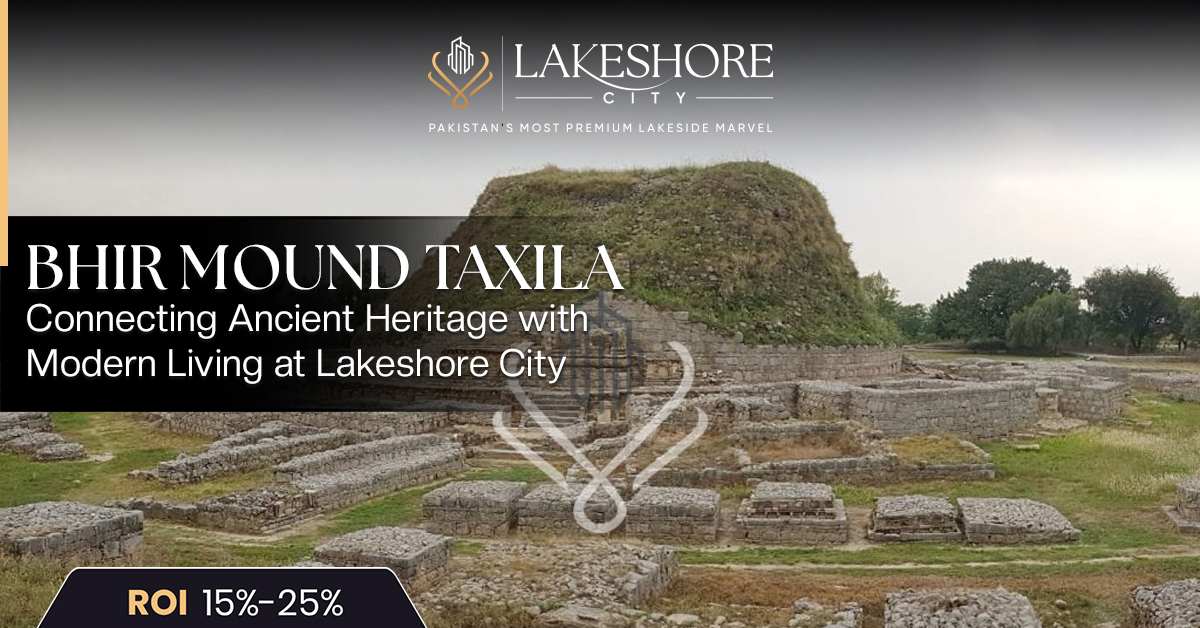
Twenty-five centuries ago, before Alexander the Great ever set foot in the Punjab, a city already stood on this soil. Traders walked its streets. Scholars debated philosophy in its courtyards. Coins changed hands in its markets, and the foundations of what we now call Bhir Mound rose stone by stone on the banks of the Tamra Nala. That city is gone. But the land that cradled it is still here — and it is still shaping how people live, invest, and dream in this part of Pakistan.
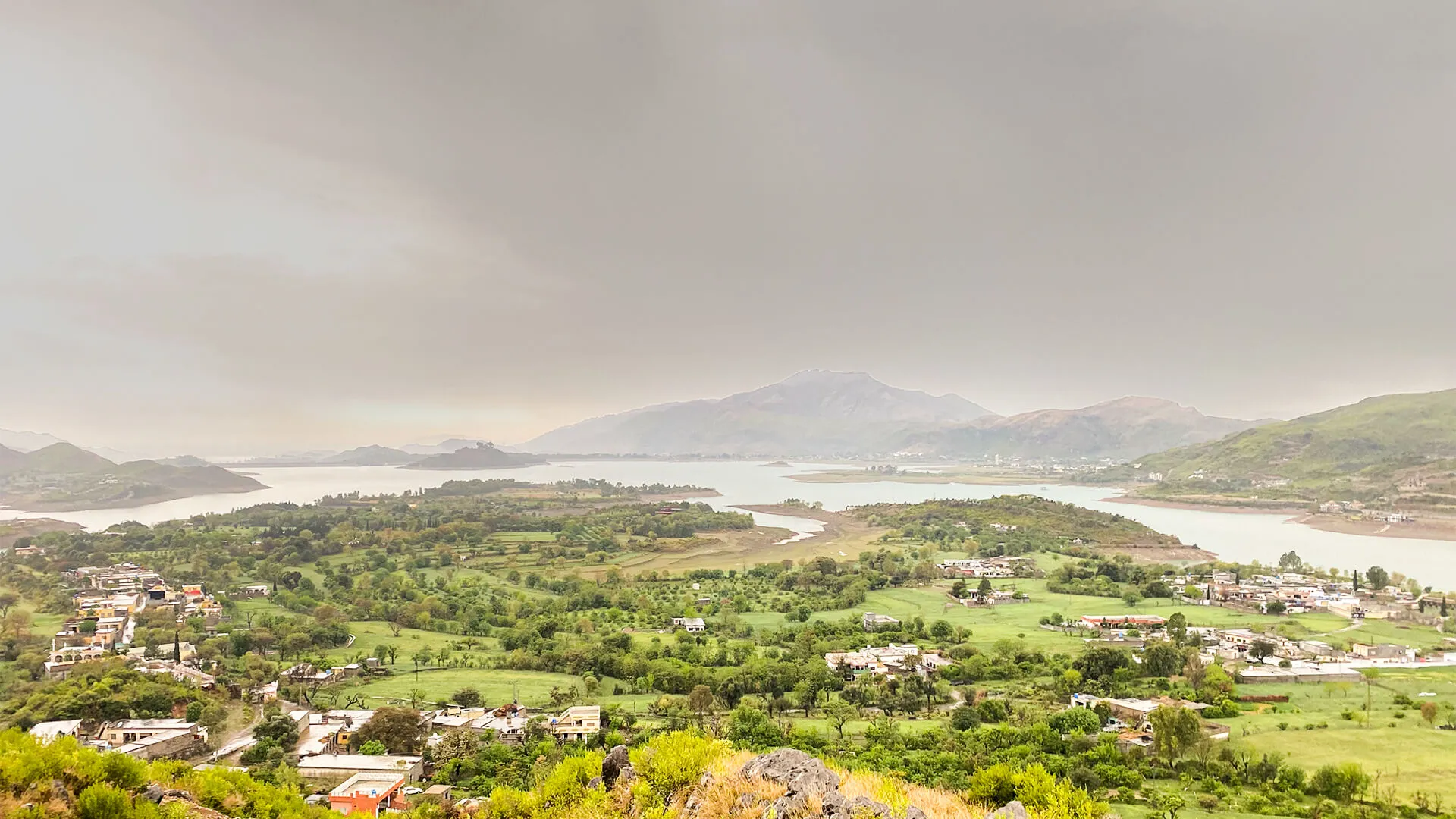
Drive twenty-five minutes from the ruins of Bhir Mound today and you arrive somewhere unexpected: a master-planned lakeside community taking shape on the edge of Khanpur Dam, where Lakeshore City is building a different kind of legacy — one measured not in millennia, but in modern infrastructure, lake views, and long-term capital growth. The connection isn’t poetic license. It’s geography, history, and investment logic meeting in the same valley.
This is the story of how one of South Asia’s oldest urban settlements explains why Taxila and its surrounding region — including Khanpur — has become one of Pakistan’s most compelling real estate frontiers for 2026 and beyond.
Bhir Mound Taxila: The City Where South Asian Urban History Began
Bhir Mound is not just another ruin scattered across the Taxila valley. Archaeologists consider it the earliest excavated urban settlement in the region, with foundations dating back to roughly the 6th century BCE under Achaemenid rule. Long before Lahore, Islamabad, or even Rawalpindi existed in any recognizable form, Bhir Mound was functioning as a planned city — with residential quarters, marketplaces, and the kind of organized street layout that archaeologists rarely find this far back in the historical record.
UNESCO recognized the broader Ruins of Taxila, including Bhir Mound, as a World Heritage Site in 1980, citing the area’s unmatched value in tracing more than five centuries of continuous urban evolution on the Indian subcontinent. Few places on Earth let you walk through that much layered history in a single afternoon.
The Gandhara Connection
Bhir Mound sits at the heart of the ancient Gandhara civilization, a cultural and artistic tradition that fused Persian, Greek, Central Asian, and South Asian Buddhist influences into something entirely its own. This was the world’s first great laboratory of cultural fusion — and Taxila was its capital of ideas. Students and scholars are believed to have traveled here from as far as Persia and Central Asia to study at what many historians regard as one of the subcontinent’s earliest centers of organized learning.
When Alexander the Great’s forces reached Taxila in 326 BCE, Bhir Mound was already a thriving city under the local ruler Ambhi, who chose alliance over resistance. Decades later, the Mauryan Empire — including a young prince named Ashoka — governed the region from this very ground before the Greco-Bactrians eventually shifted the capital to nearby Sirkap. Few addresses anywhere carry that kind of resume.
To understand how deep this heritage runs across the wider valley, it’s worth exploring the
ancient Buddhist monasteries scattered across the hills near Khanpur documented in this detailed regional guide, which traces how monastic life flourished alongside the trade routes that once ran through this exact corridor.
And for readers who want the fuller archaeological picture — from Sirkap’s Greek-influenced grid streets to the Dharmarajika Stupa — the wider story of Taxila’s place within Gandhara civilization is laid out comprehensively in this exploration of
the ancient treasures of Taxila and Gandhara, a useful companion piece for anyone weighing both the cultural and investment dimensions of this region.
Lakeshore City: Where Heritage Meets a Modern Master Plan
Heritage tourism and real estate rarely get discussed in the same sentence in Pakistan. They should. A region with 2,500 years of continuous human settlement isn’t a coincidence of fertile land and a river — it’s evidence of something planners have understood since antiquity: this valley, anchored by the natural beauty of Khanpur Dam and within easy reach of Taxila and Islamabad, has always been a place people choose to stay.
Lakeshore City is built on that same instinct, translated into 2026 standards. Instead of organic growth around a market square, the development follows a master-planned layout with dedicated zones for residential living, green belts, lakefront access, and commercial activity — the same fundamentals that made ancient Taxila livable, reimagined with modern engineering, paved infrastructure, and sustainable land use.
Urban Planning With a Sense of Place
- Lakefront-oriented layout designed around Khanpur Dam’s natural waterline and topography
- Wide carriageways and planned road networks connecting directly to the regional infrastructure grid
- Dedicated green spaces and landscaped corridors rather than dense, unplanned construction
- Zoned development separating residential calm from commercial convenience
- Proximity to one of Pakistan’s most significant UNESCO heritage corridors, supporting long-term tourism-linked demand
This is the difference between buying land and buying into a place with context. Owning property near Bhir Mound and the Taxila heritage corridor means your investment sits inside a destination that draws historians, students, diplomats, and tourists year-round — not just commuters.
If you want the financial case for entering at this stage of the development, the analysis in why investing early in Lakeshore City Taxila is a smart move breaks down the timing argument in detail, particularly around current installment pricing versus projected post-development valuations.
Why Taxila and Khanpur Are Pakistan’s Next High-ROI Real Estate Corridor
Real estate value rarely comes from a single factor. It consists of several moving in the same direction at once — and right now, the Taxila-Khanpur corridor has an unusually rare alignment of them.
Infrastructure Driving Land Value
Khanpur Dam already functions as one of the twin cities’ favorite weekend escapes, drawing visitors from Islamabad and Rawalpindi for boating, hiking, and lakeside leisure. Add to that ongoing road network upgrades — including the Alexander Road corridor and improvements tied to the Khanpur Dam tunnel project — and the area is steadily closing the accessibility gap that once kept it feeling remote.
Reduced travel time has a direct, well-documented relationship with land appreciation in emerging Pakistani real estate corridors. As connectivity improves, demand follows — and pricing typically moves ahead of the infrastructure completion date, not after it. That timing gap is exactly where early investors capture the most value.
Tourism as a Long-Term Demand Engine
Taxila’s UNESCO status isn’t just a cultural footnote — it’s an economic asset. Heritage tourism brings recurring footfall that doesn’t depend on a single industry’s boom-and-bust cycle. Students, researchers, school trips, international tourists, and domestic weekend travelers create a layered, durable demand base for hospitality, retail, and residential development in the surrounding area.
Lakeshore City’s position within this corridor means its growth story isn’t purely speculative. It’s tied to a destination that has already proven, for over two thousand years, that people are drawn to this exact stretch of land.
Realistic Appreciation Expectations
Infrastructure-driven corridors near Islamabad have historically delivered strong appreciation as roads, utilities, and tourism amenities mature. Based on comparable development patterns in the wider Taxila-Khanpur belt, a realistic appreciation range for well-positioned plots over the medium term sits in the 15 to 25 percent band, contingent on phase, location within the master plan, and the pace of surrounding infrastructure completion. As with any real estate investment, this is a projection grounded in regional trends rather than a guarantee, and prospective buyers should verify current pricing and payment terms directly with the Lakeshore City sales team before committing.
Life at Lakeshore City: Modern Comfort, Natural Calm
Strip away the investment spreadsheet for a moment and ask a simpler question: what does it actually feel like to live here? The answer is the part most brochures undersell.
Lakeside Living, Reimagined
Waking up to a view of Khanpur Dam’s water rather than a neighbor’s boundary wall changes the daily rhythm of life in ways that are hard to quantify but easy to feel. Lakeshore City’s planning leans into this — positioning residential blocks to take advantage of natural sightlines toward the lake and surrounding hills rather than treating the water as an afterthought.
A Genuine Connection to Nature
- Cooler microclimate compared to dense urban centers, thanks to the lake and surrounding greenery
- Walkable green corridors designed for morning routines, not just landscaping photos
- Proximity to hiking trails and the natural terrain around Khanpur Dam
- Lower noise and air pollution levels typical of large lakeside developments outside dense city cores
Community Without Compromise
None of this requires giving up modern convenience. The development is planned with schools, healthcare access, retail nodes, and security infrastructure built into the master plan from day one — the same fundamentals families look for in any serious housing society, paired with a setting most Islamabad and Rawalpindi developments simply cannot replicate.
There’s also something quietly meaningful about raising a family or building a weekend retreat within sight of a UNESCO World Heritage corridor. History becomes a Sunday drive, not a textbook chapter. For families and young professionals weighing where to put down roots, that proximity carries a cultural value that doesn’t show up on a price sheet but shapes how a place feels like home.
Frequently Asked Questions
What is Bhir Mound Taxila known for?
Bhir Mound is recognized as the earliest excavated urban settlement in the Taxila valley, dating to around the 6th century BCE. It is part of the Ruins of Taxila UNESCO World Heritage Site and is historically linked to Alexander the Great’s entry into the region in 326 BCE.
How far is Lakeshore City from Taxila?
Lakeshore City is located near Khanpur Dam, within the same broader Taxila tehsil of Rawalpindi district, placing it within a short, convenient drive of the Taxila heritage sites and Taxila Museum.
Is Taxila a UNESCO World Heritage Site?
Yes. Taxila, including Bhir Mound, Sirkap, and Sirsukh, was inscribed as a UNESCO World Heritage Site in 1980 for its role in documenting more than five centuries of urban evolution on the subcontinent.
Why is the Taxila-Khanpur corridor a good real estate investment?
The corridor benefits from improving road infrastructure, proximity to Islamabad and Rawalpindi, established heritage tourism demand, and the natural appeal of Khanpur Dam — a combination of factors that typically drives sustained land appreciation in emerging Pakistani real estate markets.
What makes Lakeshore City different from other housing societies near Islamabad?
Lakeshore City is positioned directly along Khanpur Dam with a master plan built around lakefront access, green corridors, and proximity to a UNESCO heritage corridor — a combination of natural and cultural assets that most standard housing societies in the twin cities cannot offer.
What was the Gandhara civilization and how does it relate to Taxila?
Gandhara was an ancient cultural region blending Persian, Greek, Central Asian, and Buddhist influences, with Taxila serving as one of its principal centers of learning, trade, and governance from roughly the 6th century BCE to the 5th century CE.
Is it safe to invest in property near Khanpur Dam?
As with any real estate purchase in Pakistan, buyers should verify land titles, NOC status, and developer documentation directly through official channels before investing. Prospective buyers are encouraged to confirm current regulatory and payment plan details directly with the Lakeshore City sales office.
Can tourists visit Bhir Mound and Taxila Museum in the same trip?
Yes. Bhir Mound sits close to the Taxila Museum, which houses an extensive collection of Gandharan art and artifacts, making it possible to combine both visits comfortably in a single day trip from Islamabad or Rawalpindi.