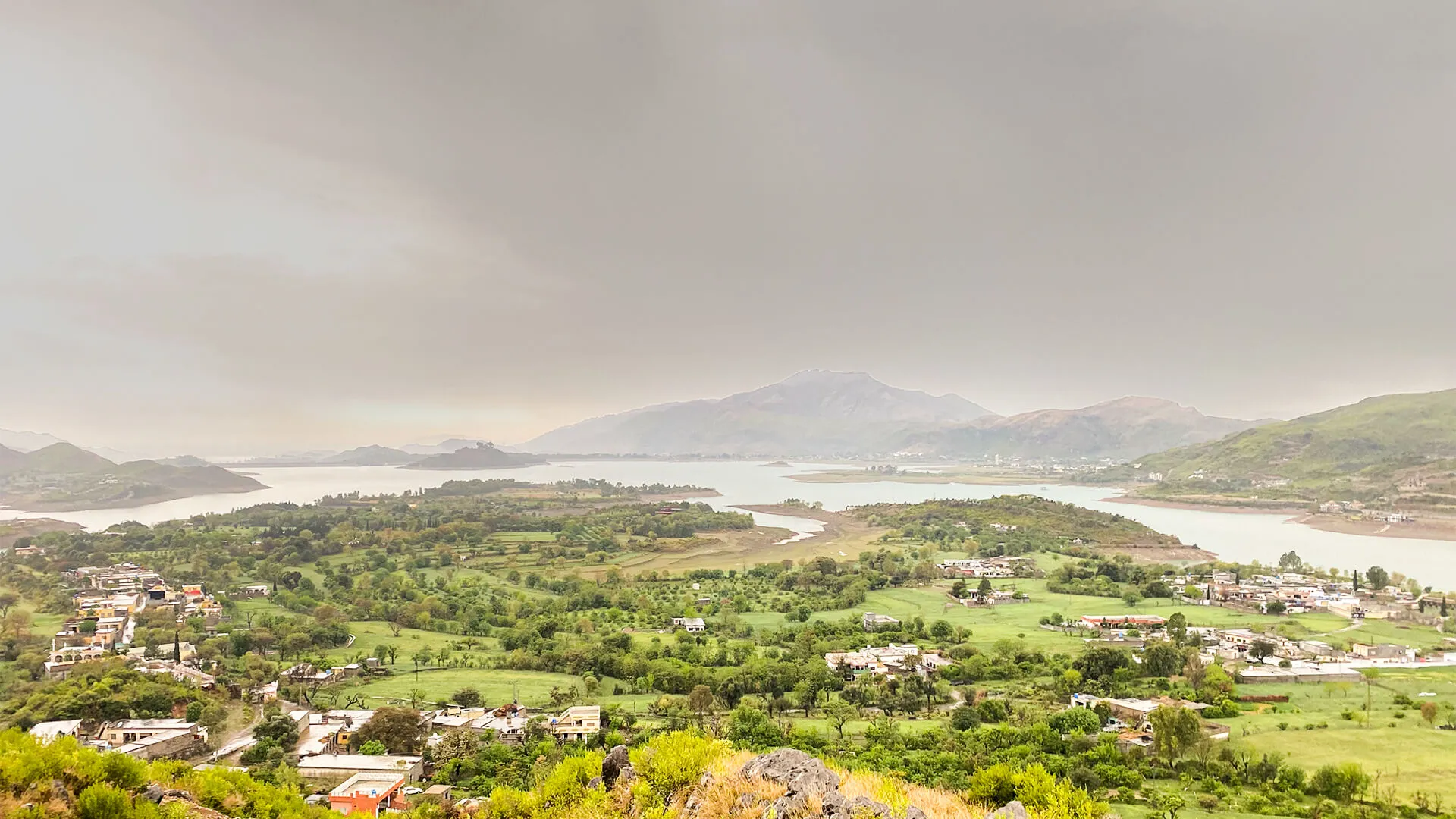
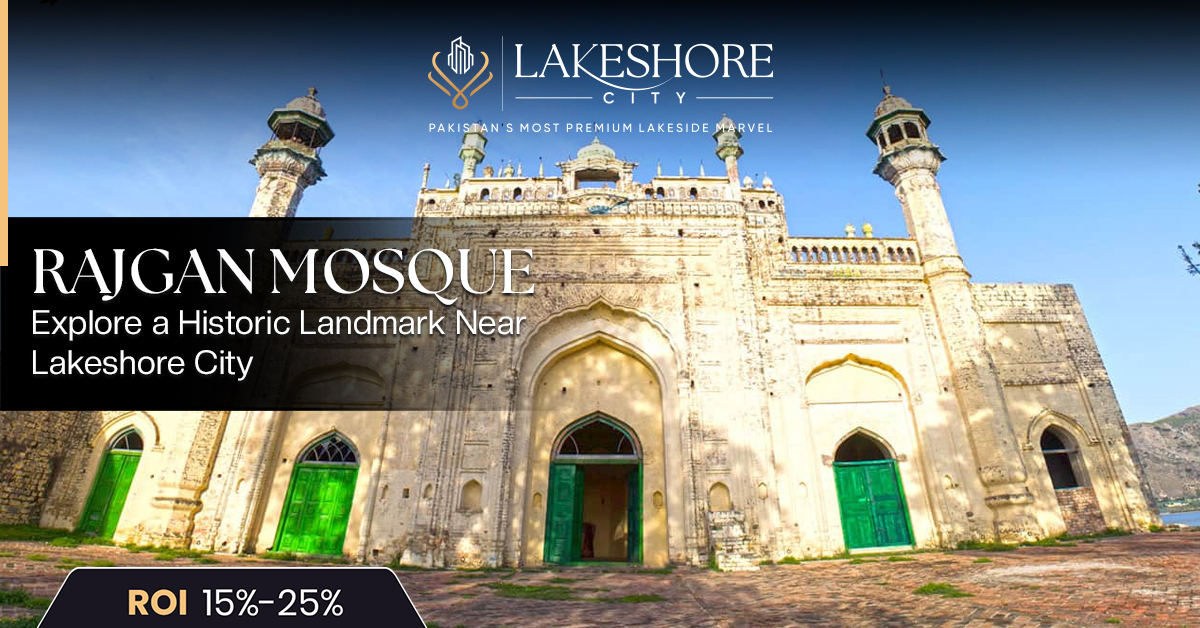
Rajgan Mosque, locally known as Rajon ki Masjid, is a 19th-century mosque built in 1872 on the bank of Khanpur Dam. Its Mughal-inspired minarets and arched gateways, modeled on Delhi’s Jama Masjid, make it one of the region’s most distinctive heritage sites — and one that sits close to Lakeshore City on the shores of the same lake.
Pakistan keeps a surprising amount of its history half-hidden. Some of it sits under museum glass in Taxila. Some of it, like Rajgan Mosque, sits partly under water for months at a time, only to resurface each year as the level of Khanpur Dam drops and reveals a structure that has outlasted the town it once served.
For travelers exploring the hills and reservoir around Khanpur, the mosque is one of the more unexpected stops on the map. It is not a polished monument with a ticket booth and a gift shop. It is a working piece of 19th-century history that residents still gather at for Eid prayers, and its story is tied directly to the same shoreline where Lakeshore City now stands.
What Is Rajgan Mosque?
Rajgan Mosque, commonly called Rajon ki Masjid — the “Mosque of the Rajas” — was built in 1872 by Raja Sultan Jehandad Khan, a local chieftain and the founder of the original Khanpur town. That town no longer exists in its old form. When Khanpur Dam was constructed on the Haro River in the late 1970s, the reservoir it created submerged the settlement and displaced its residents to what is now known as new Khanpur.
The mosque survived. Positioned near the northern edge of the dam, it now stands mostly deserted for much of the year, reachable by boat, and used chiefly for Eid congregations when families return to the site their grandparents once called home. Local accounts describe it as roughly 150 years old, a figure that lines up with its 1872 construction date and its recognition among heritage writers and travel journalists covering Khyber Pakhtunkhwa.
Historical Importance of Rajgan Mosque
Rajgan Mosque is a rare surviving marker of pre-dam Khanpur. Before the reservoir existed, the mosque anchored a functioning town — a hub for daily prayer, community gatherings, and, according to local elders, religious education for seminary students who lived in rooms attached to the building.
That history matters beyond nostalgia. Sites like this preserve a version of regional identity that would otherwise be entirely underwater, literally and figuratively. Despite its age and architectural pedigree, the mosque has never been granted formal protected-heritage status, which has left much of its restoration and preservation to time, weather, and the goodwill of visitors rather than any dedicated conservation program.
Architecture and Design
The mosque was designed with the help of artisans brought in from Delhi, and it shows. Its layout borrows directly from Mughal religious architecture: two large minarets and two smaller ones flank a central dome, and four arched entrances — along with the main gateway — are modeled on the Jama Masjid in Delhi, built under Emperor Shah Jahan between 1650 and 1656.
Builders used chiseled black stone for the boundary walls and locally fired brick for the main structure, with timber for doors and fittings reportedly sourced from the Leepa Valley. At its peak, the prayer hall could hold close to a thousand worshippers — an unusually large capacity for what was, at the time, a modest riverside town. The scale of the building says something about how much importance the community placed on it.
Why Visit Rajgan Mosque?
The appeal isn’t polish — it’s atmosphere. A mosque that emerges from a lake, weathered but still structurally intact after a century and a half, has a presence that newer buildings simply don’t. For photographers, the contrast between still water, exposed brick, and Mughal-style arches makes for some of the more striking heritage shots in the Khanpur area, particularly around sunset.
History enthusiasts get a genuine architectural case study in Mughal-influenced design outside the major tourist circuits. Families get an easy half-day outing that pairs naturally with boating on Khanpur Lake or a stop at nearby Mabali Island. And for anyone already exploring the wider region’s Buddhist and Gandharan sites around Taxila, Rajgan Mosque adds an Islamic-era layer to a heritage trail that already spans several centuries.
Rajgan Mosque and Lakeshore City
Lakeshore City sits on the same Khanpur Dam shoreline as Rajgan Mosque, along the Taxila–Haripur GT Road. That proximity is less about real estate marketing and more about geography: residents and visitors based at Lakeshore City are already positioned within easy reach of one of the region’s more distinctive heritage sites, along with Khanpur Dam’s water sports, Mabali Island, and the museums and Buddhist stupas around Taxila.
It’s a practical kind of access rather than a curated one. Someone spending a weekend at Lakeshore Club can combine time on the water with a short boat trip toward the mosque, or plan a slower Sunday around Khanpur’s older sites before heading back for the evening. People weighing a longer-term move can browse plots and layouts through Lakeshore Residencia, and anyone ready to move forward can register directly through the developer’s site. None of that requires treating heritage tourism as a selling point — it’s simply part of what the location already offers.
Those already familiar with the club amenities can explore Lakeshore Club to see what a weekend on the water looks like before adding the mosque to the itinerary.
Anyone comparing residential options can discover Lakeshore Residencia to review plot sizes and layouts along the same shoreline.
A mosque built for a town that no longer exists, still standing on the edge of the water that replaced it.
| Key Takeaways 1. Rajgan Mosque was built in 1872 by Raja Sultan Jehandad Khan, founder of the original Khanpur town. 2. Its architecture — twin minarets, a central dome, and arched gateways — is modeled on Delhi’s Jama Masjid. 3. The mosque survived the submersion of old Khanpur when Khanpur Dam was built in the late 1970s. 4. It sits on the same Khanpur Dam shoreline as Lakeshore City, reachable by a short boat trip.The site has no formal heritage 5. 5. protection, so responsible, respectful visits matter. |
| Interesting Facts The mosque’s arched entrances were modeled on Delhi’s Jama Masjid, built under Shah Jahan between 1650 and 1656. It once had the capacity to hold close to 1,000 worshippers. Artisans were brought in from Delhi specifically to design and build it. The mosque is one of several South Asian heritage sites that periodically reappear as reservoir water levels drop, alongside sites like the Shah Daula Shrine at Mangla Dam. |
Travel Tips for Visitors
A few practical notes before planning a trip:
- Best time to visit: Outside peak monsoon season (roughly July to September), when rising water levels can partially surround the mosque and limit access. Cooler months offer easier boat access and more comfortable walking conditions.
- Dress code: This is an active place of worship. Modest, conservative clothing is expected for all visitors, regardless of religion.
- Photography etiquette: Photography is generally welcome, but ask before photographing worshippers directly, and avoid using flash or drones during prayer times.
- Prayer hours: The mosque is used for Eid congregations and occasional prayers. Time visits outside these gatherings if the goal is quiet exploration, or attend respectfully if visiting during Eid.
- Responsible tourism: The site has no formal caretaker or protected status, so visitors should avoid climbing on fragile sections, removing stones or fragments, or leaving litter behind.
- Local customs: Boatmen and local guides in the Khanpur area can usually arrange transport to the mosque — engaging them respectfully also supports the local community that maintains informal access to the site.
Conclusion
Rajgan Mosque isn’t a restored showpiece, and that’s part of what makes it worth seeing. It’s a working record of a town that no longer exists, still standing where its builders placed it more than a century ago. Preserving sites like this — even informally, through respectful visits and local memory — keeps a thread of Pakistan’s religious and architectural history intact for the next generation to find.
For anyone based at or visiting Lakeshore City, that history is close by rather than a planned excursion. A weekend can move easily from the amenities at Lakeshore Club to a quiet boat ride toward the mosque, with the option to check the current payment plan or register directly with Lakeshore City whenever the timing feels right.
Frequently Asked Questions
What is Rajgan Mosque known for?
Rajgan Mosque is known for its Mughal-inspired architecture, its arched gateways modeled on Delhi’s Jama Masjid, and its unusual history as one of the few structures to survive the submersion of old Khanpur town when Khanpur Dam was built.
How old is Rajgan Mosque?
The mosque was built in 1872 by Raja Sultan Jehandad Khan, making it roughly 150 years old.
How do you get to Rajgan Mosque?
The mosque sits on the edge of Khanpur Dam and is typically reached by boat from the surrounding shoreline, including the area near Lakeshore City.
Is Rajgan Mosque still used for prayers?
Yes, though it stands largely deserted for most of the year, it is still used for Eid congregations and occasional prayers by families with ties to the original Khanpur town.
Is Rajgan Mosque near Lakeshore City?
Yes. Lakeshore City is located on the same Khanpur Dam shoreline along the Taxila–Haripur GT Road, placing residents and visitors within short reach of the mosque and other Khanpur-area attractions.
What other historic sites are near Rajgan Mosque?
Nearby attractions include Mabali Island, Khanpur Dam’s recreational areas, and the Buddhist and Gandharan heritage sites around Taxila, including Jaulian Monastery and the Taxila Museum.
Is Rajgan Mosque officially protected as a heritage site?
No. Despite its age and architectural significance, Rajgan Mosque has not been granted formal protected-heritage status, and it currently relies on informal community care rather than a dedicated conservation program.