
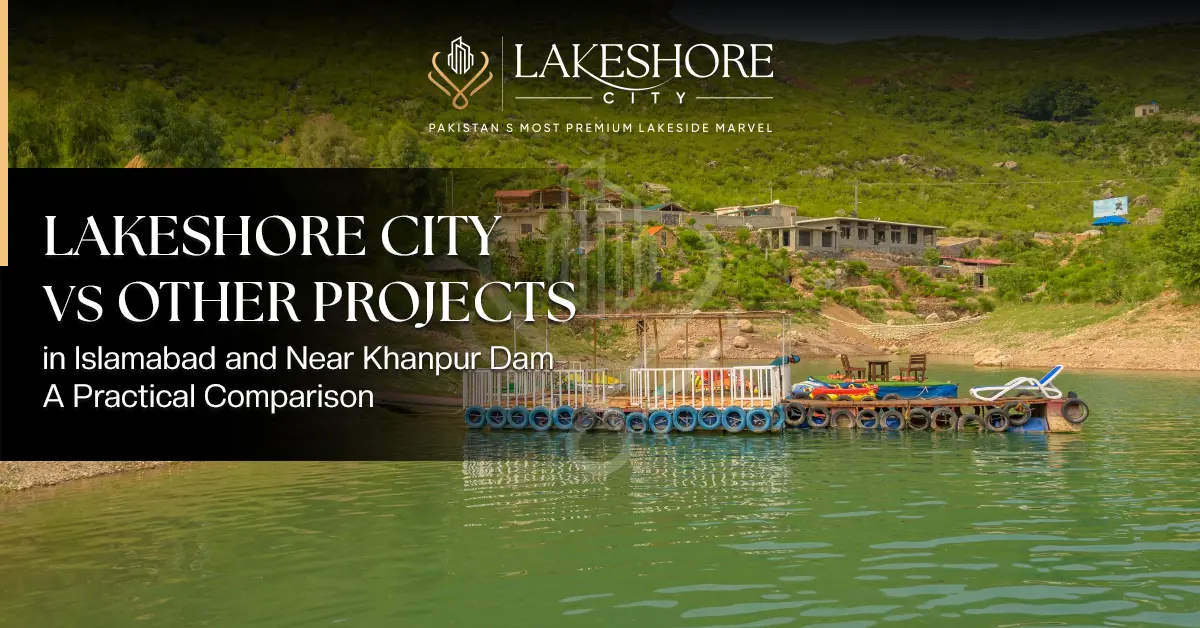
Choosing the right real estate project requires more than comparing prices or location. Buyers today are increasingly focused on development stage, infrastructure quality, long-term growth potential, and actual usability. When making a Lakeshore City comparison with other projects, it becomes important to evaluate how different types of developments perform over time.
Projects inside Islamabad, peripheral housing schemes, and tourism-linked developments near Khanpur Dam all follow different growth patterns. Understanding these differences helps investors make more practical decisions.
Market Position: City vs Emerging Corridors
Islamabad’s established sectors represent a mature market. These areas offer developed infrastructure, stable demand, and immediate usability. However, entry prices are significantly higher, which limits accessibility for many buyers.
Also Read: How Infrastructure Development Near Khanpur Dam Drives Long-Term Returns
In contrast, projects near Khanpur Dam and surrounding areas fall into an emerging category. These developments are still evolving, which means lower entry prices but longer investment timelines. Their value depends more on future infrastructure and regional growth rather than current demand alone.
Infrastructure and Development Progress
Infrastructure is one of the biggest differentiators between projects.
| Factor | Islamabad Projects | Emerging Projects Near Khanpur Dam | Planned Development (e.g, Lakeshore City) |
| Development Stage | Fully developed | Early to mid-stage | Structured phased development |
| Utilities | Fully available | Limited or under development | Planned with gradual implementation |
| Road Access | Strong and established | Improving | Integrated with project planning |
| Community Setup | Active and populated | Limited settlement | Designed for future community growth |
Planned developments tend to sit between fully developed city areas and unstructured land projects. They aim to combine early entry pricing with structured long-term planning.
Investment Timeline and Return Expectations
Different project types require different expectations.
- Islamabad projects typically offer stable but slower appreciation because prices are already mature.
- Unplanned or early-stage projects may show price movement but often depend heavily on speculation.
- Structured developments follow a gradual growth pattern, where value increases as infrastructure and community formation progress.
In this comparison, such planned developments are positioned for long-term appreciation rather than short-term gains.
Lifestyle and Living Environment
Living conditions vary significantly across these categories.
City-based projects offer convenience, access to services, and established communities. However, they often come with congestion, higher population density, and limited open space.
In contrast, areas near Khanpur Dam provide open landscapes, natural surroundings, and lower noise levels. Planned communities in such locations attempt to combine these lifestyle benefits with structured residential planning.
This creates an alternative living model that focuses more on space, environment, and long-term comfort.
Risk and Stability Comparison
Each category carries a different level of risk.
- Islamabad properties: Lower risk due to established demand and infrastructure
- Unplanned developments: Higher risk due to legal, infrastructure, and demand uncertainty
- Planned projects: Moderate risk, depending on execution and development consistency
Risk in emerging areas is not necessarily negative, but it requires patience and proper evaluation.
Pricing and Accessibility
Pricing is often the main reason buyers compare different projects.
Islamabad sectors require high upfront investment, making them less accessible for new buyers. In contrast, projects near Khanpur Dam offer lower entry prices.
Structured developments, including Lakeshore City, often introduce installment-based models. This allows buyers to enter the market with smaller initial capital while aligning payments with development timelines.
Which Option Fits Different Buyers?
| Buyer Type | Best Fit |
| Short-term investors | Islamabad or mature areas |
| Long-term investors | Planned developments |
| Budget-conscious buyers | Emerging projects |
| Lifestyle-focused buyers | Water-side or open-space developments |
| Risk-averse buyers | Established city sectors |
This comparison shows that no single option is universally better. The right choice depends on investment goals, timeline, and risk tolerance.
Conclusion
The difference between Islamabad property and emerging projects lies mainly in timing, infrastructure, and long-term vision. While city projects offer stability and immediate usability, developments near Khanpur Dam provide lower entry points and future growth potential.
Projects like Lakeshore City sit between these categories by combining structured planning with long-term development potential. The right choice depends on how well a buyer’s expectations align with the project’s growth stage.
FAQs
How is Lakeshore City different from other projects in Islamabad?
Lakeshore City differs from Islamabad projects mainly in development stage and pricing. Islamabad offers fully developed infrastructure and immediate usability, while Lakeshore City focuses on planned development and long-term growth with lower entry prices.
Are housing projects near Khanpur Dam good for long-term investment?
Yes, housing projects near Khanpur Dam can be suitable for long-term investment if infrastructure continues to improve and demand grows steadily. These areas typically require patience as property value increases gradually over time.
Which is better: Islamabad property or emerging housing projects?
Islamabad property is better for stability and immediate use, while emerging housing projects are better for long-term growth and lower entry cost. The right choice depends on your investment timeline and risk tolerance.
Is Lakeshore City a safe investment option?
Yes, Lakeshore City is better suited for long-term investors if development continues as planned. Like any developing project, its performance depends on execution, demand growth, and infrastructure progress.
Why do investors compare planned projects with unplanned developments?
Investors compare planned and unplanned projects to understand differences in risk and structure. Planned developments offer organized infrastructure and long-term clarity, while unplanned projects may carry higher uncertainty.