
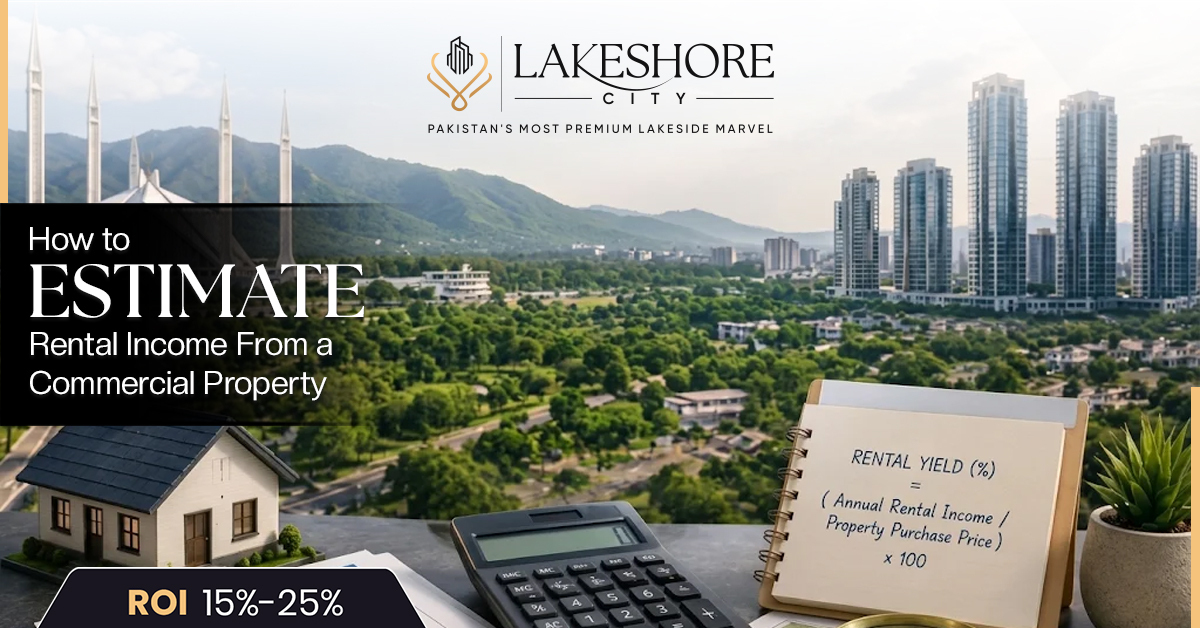
Through rental agreements, commercial property can produce consistent revenue, but determining its earning potential necessitates more than just looking at the anticipated monthly fee. To determine the true return, investors must take into account market rates, property size, occupancy, operational costs, and potential future rental increases.
Through rental agreements, commercial property can produce consistent revenue, but determining its earning potential necessitates more than just looking at the anticipated monthly fee. To determine the true return, investors must take into account market rates, property size, occupancy, operational costs, and potential future rental increases.
Start by Assessing the Market Rental Value
Estimating a commercial property’s potential rent revenue is the first step. Location, accessibility, property quality, visibility, neighboring businesses, and client demand all affect rental prices.
Investors can assess market rental value by:
- Comparing rents of similar commercial properties in the same area.
- Checking rental rates for properties with similar sizes and layouts.
- Considering road frontage, footfall and parking availability.
- Reviewing demand from businesses operating nearby.
- Consulting local property dealers and commercial leasing professionals.
An accurate market estimate serves as a foundation for figuring out rental income. Before determining rental value, investors considering commercial investment in Lakeshore City should consider the location, plot category, neighboring development, and possible company demand.
Calculate Rent According to Property Size
Commercial buildings are frequently rented based on their usable floor space or covered area. Comparing several properties is made simpler by knowing the rent per square foot.
Formula:
Monthly Rent = Rent Per Square Foot × Total Rentable Area
For example, if a commercial unit has 1,000 square feet of rentable space and the estimated rate is PKR 150 per square foot:
| Details | Amount |
| Rentable area | 1,000 sq. ft. |
| Rent per sq. ft. | PKR 150 |
| Estimated monthly rent | PKR 150,000 |
| Estimated annual rent | PKR 1,800,000 |
These figures are illustrative. Actual rental rates depend on the property’s location, condition and market demand.
When determining potential rent, property size, permitted use, and location within the commercial area are crucial considerations for investors assessing commercial prospects in Lakeshore City.
Consider the Factors That Influence Rental Income
Beyond its size, a commercial property’s earning potential depends on a number of other elements. Compared to a comparable property in a less accessible location, a well-located unit with excellent business exposure may draw more renters.
Important considerations include:
- Location: Proximity to residential communities, main roads and business activity.
- Accessibility: Convenient entry, parking and pedestrian access.
- Visibility: Road frontage and exposure to potential customers.
- Property condition: Maintenance, layout and available facilities.
- Business demand: Suitability for retail, offices, restaurants or other businesses.
- Competition: Availability of similar commercial spaces nearby.
These elements assist investors in determining appropriate tenants and estimating reasonable rental demand. The proposed commercial sections of Lakeshore City offer a chance to evaluate how the location and neighboring residential development might facilitate future business activity.
Account for Occupancy and Rental Expenses
Actual rental income is not always equivalent to expected rent. While maintenance and other operational expenses lower the amount an owner earns, a property may sit unoccupied between tenants.
Investors should account for:
- Vacancy periods between rental agreements.
- Property maintenance and repairs.
- Building management charges.
- Insurance, where applicable.
- Property taxes and other applicable charges.
- Marketing and tenant-finding expenses.
A useful calculation is:
Effective Rental Income = Potential Annual Rent − Vacancy Loss
For instance, a property’s rental income would drop by about PKR 150,000 if it could earn PKR 1,800,000 a year but was unoccupied for a month.
Before calculating net returns, investors in commercial real estate in Lakeshore City should examine any applicable maintenance agreements, development fees, and other ownership expenses.
Calculate Net Operating Income and Rental Yield
Net operating income and rental yield are two key metrics that investors use to assess the profitability of commercial properties.
Net Operating Income (NOI)
NOI represents the income remaining after deducting operating expenses from effective rental income.
Formula:
NOI = Effective Annual Rental Income − Annual Operating Expenses
For example:
| Details | Amount |
| Potential annual rent | PKR 1,800,000 |
| Vacancy allowance | PKR 150,000 |
| Effective rental income | PKR 1,650,000 |
| Operating expenses | PKR 250,000 |
| Annual NOI | PKR 1,400,000 |
Commercial Rental Yield
Rental yield measures annual rental income against the property’s purchase price.
Formula:
Rental Yield = (Annual Rental Income ÷ Property Purchase Price) × 100
A property’s gross rental yield is 9% if it costs PKR 20 million and yields PKR 1.8 million in rent annually.
Investors can compute net yield using NOI rather than gross rent for a more practical evaluation. This facilitates the comparison of commercial investment alternatives, including Lakeshore City assets under consideration.
Estimate Future Rental Income and Property ROI
Tenant demand, market conditions, and agreed-upon rent increases can all affect rental income over time. Investors should consider these factors when preparing long-term income projections.
A rental forecast should include:
- Current market rent and expected occupancy.
- Annual rent increases stated in the lease agreement.
- Potential vacancy periods.
- Expected maintenance and operating expenses.
- Changes in local business demand.
Property ROI provides a broader view of investment performance by comparing potential returns with the total amount invested. At Lakeshore City, the projected ROI ranges from 15% to 22% through rental income and property sales value, offering investors two potential avenues for returns.
For buyers considering a commercial investment in Lakeshore City, evaluating rental potential alongside location, commercial planning, and future business demand can help create a more realistic investment outlook.
Commercial Investment Opportunities in Lakeshore City
For investors looking to start enterprises or investigate rental income prospects close to Khanpur Dam, Lakeshore City has commercial real estate opportunities.
Investors assessing retail and other company purposes can choose from a variety of commercial plots in its Executive Commercial Block. When evaluating the prospective clientele for upcoming business endeavors, the project’s more comprehensive residential and leisure idea might also be pertinent.
Before investing, buyers should consider:
- Plot size and permitted commercial use.
- Location and accessibility within the development.
- Nearby residential and lifestyle facilities.
- Construction and development costs.
- Potential tenant demand and achievable rental rates.
- Ownership, payment and transfer requirements.
Exploring commercial real estate in a growing regional attraction is made possible by Lakeshore City. Before making a choice, investors should get in touch with the authorized sales staff to confirm current availability, pricing, development status, and related terms.
Conclusion
A thorough grasp of market rent, property size, occupancy, running costs, and rental yield is necessary for estimating commercial property rental income. Investors might see prospective returns more realistically by computing both gross income and net operating income.
Assessing plot location, business fit, and projected rental demand will help those considering commercial investment in Lakeshore City make wiser choices. Investors can more confidently evaluate chances when they combine thorough property research with a reasonable rental prediction.
FAQs
1. How can you determine the market rental value of a commercial property?
Consider tenant demand, size, accessibility, visibility, and condition when comparing similar properties in the same neighborhood. Local real estate professionals may also be able to assist in evaluating current rental rates.
2. How do you calculate commercial property rent per square foot?
Consider tenant demand, size, accessibility, visibility, and condition when comparing similar properties in the same neighborhood. Local real estate professionals may also be able to assist in evaluating current rental rates.
3. What factors influence commercial property rental income?
Rental income is influenced by a number of factors, including location, accessibility, visibility, property condition, neighboring companies, customer traffic, and tenant demand.
4. How do you calculate monthly and annual rental income?
To determine the possible annual rental income, multiply the monthly rent by 12. For instance, before expenses and vacancy losses, a monthly rent of PKR 150,000 yields PKR 1,800,000.
5. How do vacancy rates and occupancy affect rental income?
To determine the possible annual rental income, multiply the monthly rent by 12. For instance, before expenses and vacancy losses, a monthly rent of PKR 150,000 yields PKR 1,800,000.
6. What expenses should be deducted from commercial rental income?
Common expenses include maintenance, repairs, management charges, insurance, property taxes and other applicable operating costs. These are deducted from effective rental income to calculate NOI.
7. How do you calculate commercial rental yield and ROI?
Gross rental yield is calculated by dividing annual rent by the property’s purchase price and multiplying by 100. ROI considers the overall investment cost and financial returns over a selected period.
8. How can investors forecast rental income and annual rent escalation?
Start with current market rent, then account for occupancy, expected vacancies, operating costs and rent increases agreed in the lease. Review the forecast regularly against market conditions.