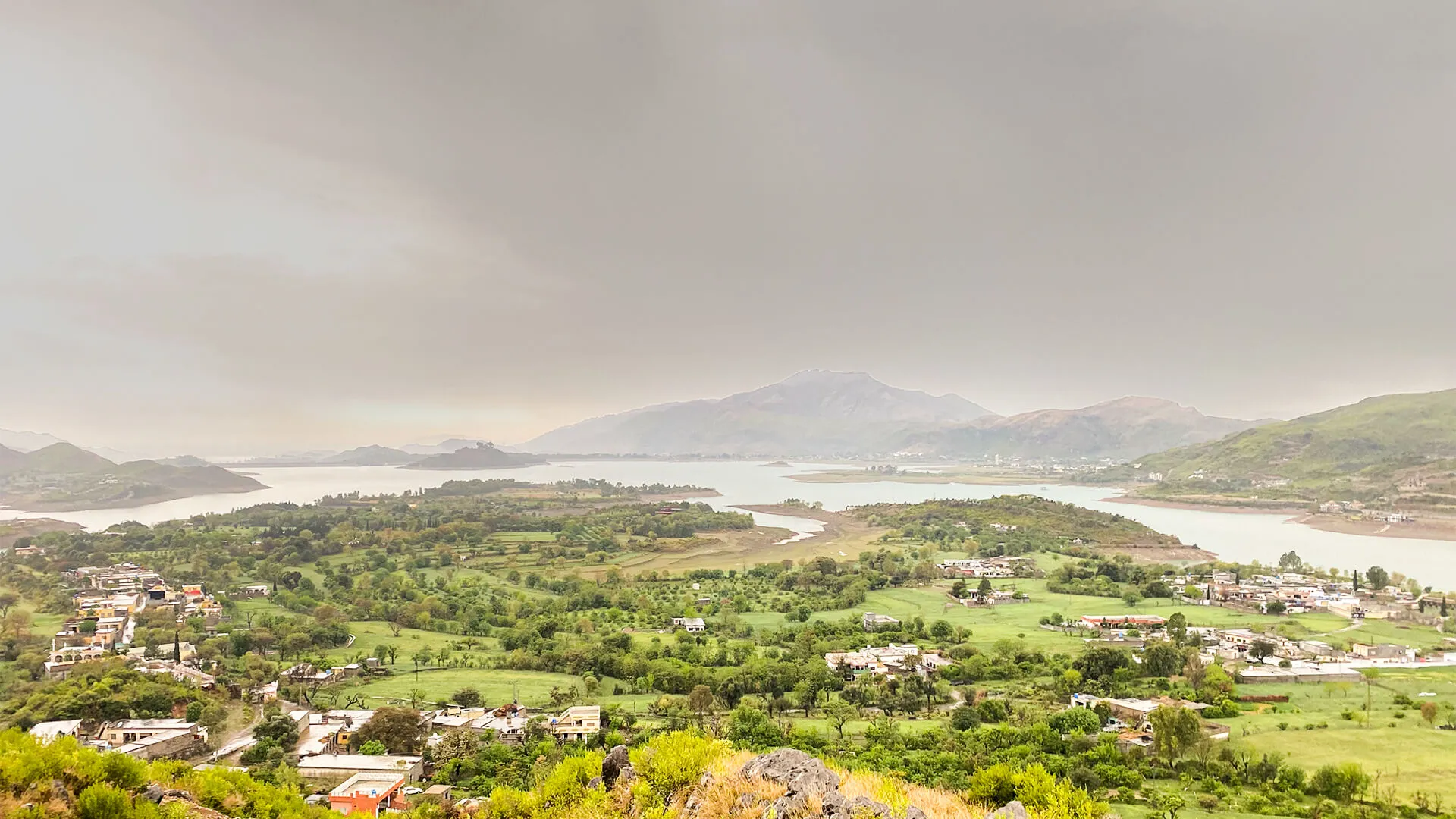

- Giri Fort is a Buddhist-era fortress and monastic site roughly 8 km northeast of Taxila, at the foot of the Margalla Hills.
- Regional heritage records date its origins to the 5th century AD; it later saw use during the early Ghaznavid period, according to local accounts.
- It sits within the wider Taxila archaeological landscape, about a 40-minute drive from Khanpur Dam and Lakeshore City.
- The site is unmanaged and undeveloped — no facilities, uneven terrain, best suited to travelers comfortable with a moderate hike.
What Is Giri Fort?
Some places announce their history with signposts and ticket counters. Others make you work for it — a gravel track, a guide who knows the way but not always the story, a spring still running inside walls nobody has fully explained. Giri Fort belongs to the second kind.
Tucked into a fold of the Margalla foothills northeast of Taxila, this Buddhist-era stronghold has watched over its stretch of the Haro valley for roughly fifteen centuries, largely undisturbed by the modern highways running past it below. For travelers exploring the Khanpur Dam and Lakeshore City corridor, it offers something increasingly rare on Pakistan’s more popular heritage trail: a genuine sense of discovery, just minutes off a well-known tourist route.
Giri Fort sits about eight kilometers northeast of Taxila, reached by a rough track past the villages of Khurram Gujar and Khurram Paracha. The site holds two clusters of Buddhist remains — a monastery and stupa on the hilltop, and a second set lower on the slope — along with the fort itself, perched above a natural spring. Archaeologists count it among the outlying structures of the greater Taxila complex, the ancient seat of Gandharan civilization and a UNESCO World Heritage Site since 1980. Giri Fort itself lies outside the formally inscribed UNESCO boundary, but it shares the same Gandharan lineage, and Pakistan’s Department of Archaeology now oversees the location.
The History Behind Giri Fort
Regional heritage records place the fort’s origins in the 5th century AD, attributing its construction to Buddhist monks who used the hilltop’s defensible position and spring-fed water source to establish a monastic stronghold. Local accounts also describe a later occupation by Sultan Masud, son of Sultan Mahmud of Ghazni — though this chapter rests more on oral tradition than on published excavation reports, and is best read as regional lore rather than settled fact.
What survives today is fragmentary: stone wall lines, the footprint of monastery cells, and stupa mounds worn down by centuries of monsoon rain. Taxila’s broader archaeological record, mapped since Sir Alexander Cunningham’s nineteenth-century surveys and later expanded by Sir John Marshall, places Giri Fort within a network of more than fifty sites that once made the region a center of Buddhist learning and trade along the ancient routes linking Central Asia, Western Asia, and the Indian subcontinent.
Why Giri Fort Is Worth Visiting
The climb rewards patience. From the hilltop, the Haro valley opens into terraced fields, orchard rows, and the blue ridge of the Margallas beyond. Photographers find real texture here — weathered stone against green hillside, shifting light through pine and peach trees at dusk.
Because so few visitors make the trip, the site keeps a stillness that busier heritage spots have long since lost. For students of Gandharan history, the layered ruins offer a physical lesson in how monasteries, forts, and later structures stacked on top of one another across centuries. Families should weigh the terrain first: paths are uneven, there are no railings, and the walk suits older children and adults far better than toddlers or anyone with mobility concerns.
Things to Do Around Giri Fort
Most visitors treat Giri Fort as the centerpiece of a half-day loop rather than a single stop. The short hike up from the parking point doubles as a nature walk through peach and loquat orchards. The hilltop clearing makes a natural rest point for a packed lunch, with sweeping views standing in for any built infrastructure — there are no cafes or stalls on site, so plan accordingly.
Photographers tend to arrive in the late afternoon, when low sun catches the stone at an angle. Paired with a stop at Dharmarajika Stupa or Taxila Museum on the way in, the fort rounds out a full weekend outing from Islamabad or Rawalpindi.
Explore the Beauty Around Khanpur Dam
Roughly forty minutes further along the same Taxila–Haripur corridor, Khanpur Dam offers a different register of natural beauty. Built on the Haro River and completed in 1983, the dam holds back a blue-green lake framed by the Hazara hills, with boating, jet skiing, and lakeside picnic spots drawing weekend crowds from the twin cities.
Where Giri Fort rewards quiet exploration, Khanpur Dam delivers open water, cooler air, and activities built for families. Together, the two sites make a natural pairing: history in the morning, lake air in the afternoon.
Giri Fort vs. Khanpur Dam: At a Glance
| Giri Fort | Khanpur Dam | |
|---|---|---|
| Best for | History, photography, quiet exploration | Boating, water sports, family outings |
| Terrain | Hilltop hike, uneven paths, no facilities | Lakeside, mostly level, resorts nearby |
| Ideal duration | 2–3 hours | Half day to full day |
| Accessibility | Not wheelchair accessible | Generally accessible near main areas |
How Lakeshore City Complements the Experience
Lakeshore City sits within this same Khanpur Dam setting, positioned as a planned residential community built around the lake rather than apart from it. For travelers who fall for the area on a day trip, the development offers a way to stay connected to it longer term.
Residential plots are available through Lakeshore Residencia
Membership includes access to the lake, event spaces, and recreational facilities through Lakeshore Club
None of this replaces ordinary due diligence. As with any property decision, prospective buyers should review the current payment plan and confirm details directly before registering interest.
You can review the current Payment Plan
What Lakeshore City does offer, credibly, is proximity — to Giri Fort’s quiet history, to the dam’s open water, and to Islamabad, roughly a half-hour’s drive away.
or start the process directly through the Clients Booking Form
Travel Tips Before Visiting
- Best season: October to March for cooler hiking weather, or early spring for orchard blossoms along the trail.
- Footwear: sturdy, closed-toe shoes — the path is loose gravel and rock, not a paved trail.
- Hydration: carry your own water; there is nothing to buy on site.
- Photography: aim for late afternoon light on the stone ruins.
- Heritage etiquette: avoid climbing on fragile wall sections and carry out any trash.
- Safety: a local guide familiar with the route is genuinely useful, since signage is minimal.
- Family travel: better suited to older children and adults than to toddlers or anyone with limited mobility.
- Vehicle: a car can manage the approach, but a jeep or high-clearance vehicle handles the last stretch more comfortably.
Visitor Checklist
| Before You Go Water and light snacks Closed-toe walking shoes Camera or phone with charge for photos Cash for fuel and any guide assistance (no facilities on site) A local guide or downloaded map, since Google Maps is unreliable for the final stretch |
Frequently Asked Questions
What is Giri Fort known for?
Giri Fort is known as a Buddhist-era monastic stronghold near Taxila, built around a hilltop spring and set within the broader Gandharan archaeological landscape. It draws heritage travelers and photographers looking for a quieter alternative to Taxila’s more visited sites.
How old is Giri Fort?
Regional heritage records date the site’s origins to roughly the 5th century AD, making it contemporary with several of the monastic complexes around Taxila. Later occupation during the early Ghaznavid period is described in local accounts, though this detail is not confirmed by published excavation records.
Is Giri Fort part of the Taxila UNESCO World Heritage Site?
Giri Fort is counted among the outlying structural remains associated with ancient Taxila, but it lies outside the formally inscribed UNESCO boundary that covers the core Taxila sites. It shares the same Gandharan historical context and is now under the oversight of Pakistan’s Department of Archaeology.
How do I get to Giri Fort from Islamabad?
The route runs through Taxila toward Dharmarajika Stupa, then follows a rough track past Khurram Gujar and Khurram Paracha villages for a few kilometers. A car can usually manage the approach, though a jeep or high-clearance vehicle is more comfortable on the final stretch, and a local guide is recommended.
Is Giri Fort suitable for families with young children?
The hike involves uneven, unpaved terrain with no railings, which makes it more suitable for older children and adults than toddlers. Families visiting with very young children may prefer to prioritize Khanpur Dam, which offers more level ground and built facilities.
Are there facilities like food or washrooms at Giri Fort?
No. The site is undeveloped, with no washrooms, shops, or eating places on location. The nearest restaurants and lodging are near the Taxila Museum, so visitors should carry water and any snacks they need for the visit.
How far is Giri Fort from Khanpur Dam and Lakeshore City?
Giri Fort sits roughly forty minutes from Khanpur Dam along the same Taxila–Haripur corridor, making it possible to combine both in a single day trip. Lakeshore City is positioned within the Khanpur Dam area itself.
What is the best time of year to visit Giri Fort?
Cooler months, from October through March, are generally more comfortable for the hike up to the fort. Early spring adds the bonus of blossoming peach and loquat orchards along the approach trail.
Can I combine a Giri Fort visit with other Taxila attractions?
Yes. Many visitors pair Giri Fort with a stop at Dharmarajika Stupa or Taxila Museum on the way in, building a fuller day around the region’s Gandharan heritage sites before continuing on toward Khanpur Dam.
Does visiting Giri Fort require a guide?
A guide is not strictly required but is strongly recommended. Signage on the trail is minimal, and online maps have historically been unreliable for the final approach through the villages.
Final Thoughts
Giri Fort will not overwhelm anyone with grand architecture or curated exhibits. What it offers instead is quieter and, for many travelers, more memorable: a hilltop spring, centuries of layered history, and a view of the Haro valley that most visitors to the region never see. Paired with an afternoon at Khanpur Dam and a closer look at Lakeshore City, it turns a short trip out of Islamabad into a genuine weekend — one part history, one part lake, and worth the drive either way.